
Where the River Teaches
Huachuma, Hospitality, and a Hill that Knows How to Listen
We start with a simple claim: the river already did the survey.
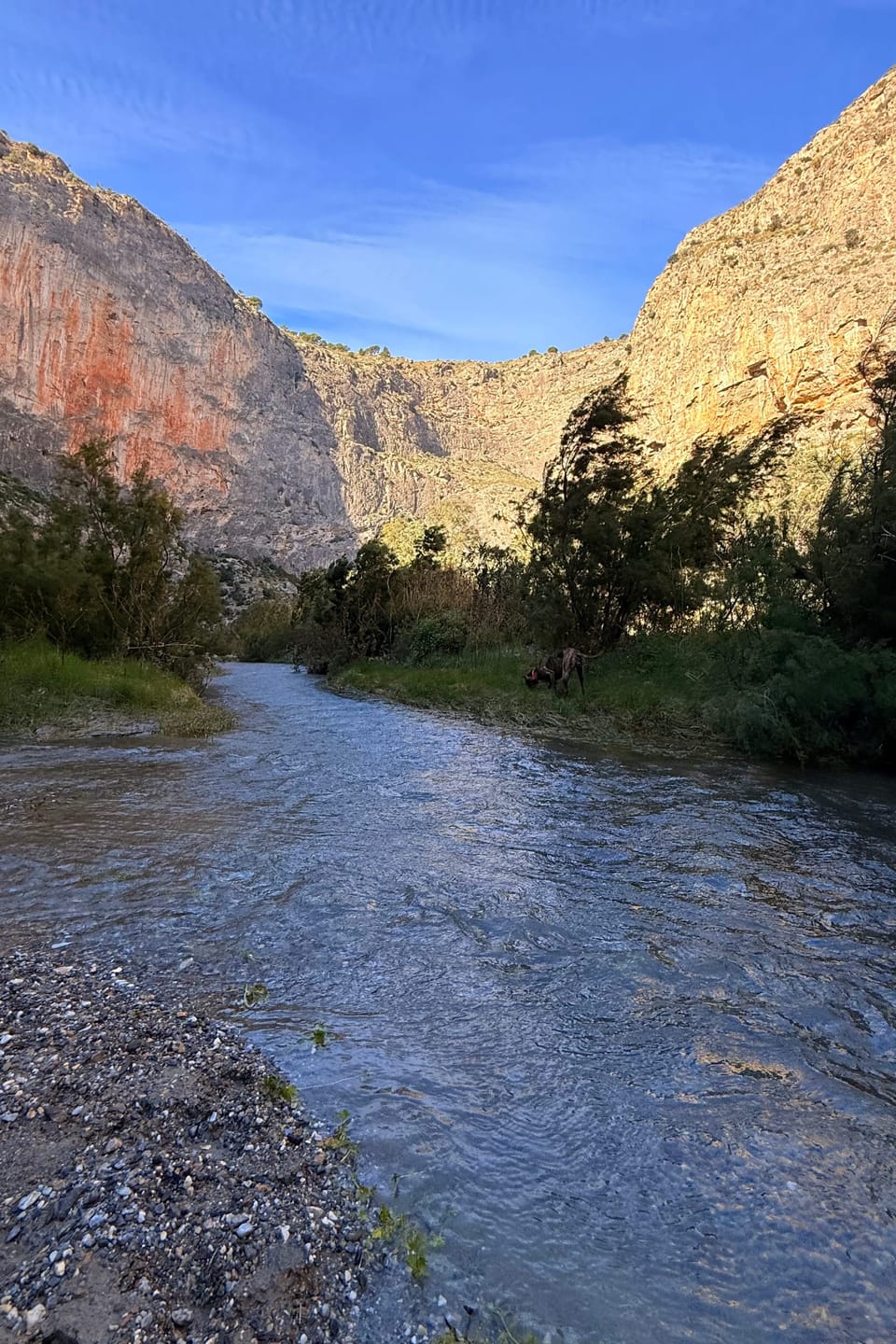
Long before we showed up with phones and contour lines, the Guadalfeo carved its opinion into every slope between the coastal plain and the snowfields above Sierra Nevada. It chose its compromises, its shortcuts, its stubborn curves. If we’re going to map this valley honestly, we don’t “use” the river as a tool. We walk beside it as the senior partner who has seen every experiment play out in sediment and stone.
To the south, the coastal hills and the bulk of Sierra de Lújar hold the towns like loose buttons on a shirt. To the north, the wall of Sierra Nevada rises white in winter and still white in stingy springs. Between them lies a tilted corridor of orchards, scrub, plastic agriculture, and the last coastal wetlands that have not yet been persuaded to forget they were wetlands. This is our laboratory and our parish.
Topographically, you can read the valley the way a botanist reads a stem: from root to leaf tip. Sea level to vega, vega to gorge, gorge to reservoir, reservoir to terrace villages, all the way up to the place where the river is no longer a river, just a set of gullies arguing over which one deserves the name. At each step the gradient changes, the soil shifts, and with it the cast of plants and animals that can afford to live there.
Ecology, in this corridor, is not a list of species but a set of loyalties. Every plant declares who it trusts: salt or fresh, shade or exposure, disturbance or neglect. Every animal is a rumor moving through those choices. Fox and genet along terrace margins; boar in neglected groves; bee-eaters stitching color over the cuts in the riverbed; swifts scissoring the evening sky above town. Even the plastic of the greenhouses has become a kind of habitat, a hot, sharp-edged desert where certain spiders and lizards have decided they can do business.
From the mouth of the Guadalfeo to the upper ravines, the land is already telling us what it can and cannot hold. If we want to ask huachuma — San Pedro cactus — to live and teach here, the least we can do is listen to what the valley is saying.
What a Highland Cactus Remembers
If huachuma is a teacher, its first classroom was the high Andean valleys of Peru and Ecuador. For thousands of years it has grown on steep, stony slopes where clouds drag their bellies across ridgelines, water is precious, and people learned to listen carefully to both.
In its native range, huachuma thrives in conditions that look contradictory on paper:
• Strong, high-angle sun and intense UV
• Cool to mild temperatures rather than brutal heat
• Steep, well-drained mineral soils
• A marked dry season, but not the total obliteration of moisture of true deserts
• Nights that can drop sharply without routinely killing mature tissue
This is not a furnace cactus.
San Pedro is a highland cactus.
Its architecture — tall, fast-growing columns with relatively thin skin — makes sense in places with bright light moderated by altitude and cloud, regular moisture pulses, and soils that drain fast but still offer trace minerals. Traditional huachuma practice emerged in agricultural landscapes: terraces, irrigation channels, smallholdings where water was directed with intelligence, not wasted.
Today, a lot of “San Pedro work” happens in places that are convenient for humans rather than ideal for the plant: imported cuttings in suburban backyards; greenhouse specimens in cold climates; stressed pots baking on concrete in the wrong desert. The ceremonies may be sincere. The ecology is often an afterthought.
If we’re going to say, “This is a good place to work with this plant outside the Andes,” the land itself has to echo the original terms of the covenant.
The Costa Tropical: A Climate That Answers Back
Granada’s Costa Tropical is not just another Mediterranean marketing phrase. It is a genuine climatic outlier.
This coast sits where the Mediterranean sea breathes mild air straight onto south-facing slopes, while Sierra Nevada and the coastal sierras block the worst of the northern cold. The result is a microclimate that manages more than three hundred days of sun a year and an annual average temperature around twenty degrees Celsius. Winters are among the softest in Europe — frost a rumor more than a rule — yet the air stays bright and dry enough to keep rot in check.
Farmers here have turned that accident of geography into a long experiment. Older generations grew sugarcane. Today, the lower Guadalfeo plain and the lower hills have become a subtropical orchard belt: mango, avocado, cherimoya, citrus, and a rotating cast of new trials. Underneath all the plastic and marketing language, the real work is the same old question: how far can you bend climate in your favor with slope, water and patience.
For a highland cactus whose roots remember terraces, irrigation channels and thin mountain soils, this matters.
Put an Andean-lineage Trichocereus pachanoi on a good south-facing terrace along this corridor and several boxes quietly tick themselves:
• Light and heat: long-season sun, but tempered by sea air and altitude — not the oven blast of continental summers.
• Water and drainage: acequias and gravity-fed channels still move water along ravines and across stone-walled terraces. Water arrives in pulses, not as constant saturation.
• Soils: rubble and alluvium — broken rock, river stone, and a century of fallen leaves — drain quickly but hold minerals.
Huachuma understands this language. Water that comes and goes. Slopes that bleed excess away from the crown. Roots that can explore stony, living ground instead of cooking inside a black plastic pot.
And all of this sits inside one of the Mediterranean Basin’s great biodiversity hotspots: mosaics of scrub, pine, oak, orchards, weed strips and wetlands, full of pollinators, mycorrhizae, and birds that braid continents together. You can surround a cactus here with mango and almond, wild fennel and thyme, native shrubs and deliberately planted herbs. It can belong to a polyculture of terraces instead of the lonely theater of a “cactus bed.”
From the plant’s perspective, this is not exile. It is a familiar dialect spoken with a new accent.
Farmers as the First Priests
Most of my conviction about this coast doesn’t come from maps or climate data. It comes from walking the seam where river, sea, and hill argue with each other.
You can start at the mouth of the Guadalfeo where it loosens into the Mediterranean — brown river folding into blue water, greenhouses catching first light like a second, uglier sea. From there, if you follow the coastal path on foot rather than by car, the story changes in small, steady increments: concrete to scrub, scrub to terraces, terraces to ravines that still remember what wild meant.
Somewhere between Motril and the first real rise of the Alpujarras, you start seeing the columns.
Not in curated shrine gardens, but in the background of work. A stand of pachanoi holding the corner of a mango terrace. A single old column leaning against a whitewashed caseta, ribs scarred from some forgotten storm. A row of rooted cuttings marching up a new bank where somebody decided erosion control and devotion could be the same job.
Further up, where the track turns to ruts and the wind comes straight down the barranco, you meet the men who keep those columns standing.
They don’t look like “plant medicine facilitators.” They look like what they are: small farmers and peasant engineers in sun-bleached caps and football shirts from three seasons ago. One hand on a saw, one hand on the trunk, talking to the cactus in the same half-muttered tone they use for their dogs and tractors.
The cutting itself is never casual. There’s always a pause — eyes up to the sky, across the slope, down toward the tank that’s already lower than they’d like. Only then do they lean in and start the teeth moving. A three- or four-meter length of cactus lets go with a soft, fibrous sigh and suddenly there is a question lying on the ground: roots or medicine?
Either way, the next move is patience.
The fresh-cut column doesn’t go straight into a pot or a brew. It gets laid gently on old boards in the shade, callus side up to the dry air. A week, two weeks, sometimes more — long enough for the wound to harden into something that can face soil again without rotting. In that limbo, men walk past with hoses and buckets, checking with the back of one knuckle the way you’d test a loaf of bread: ready yet?
When it is, the choreography shifts uphill.
On a terrace above Ítrabo or Vélez, a chestnut stake goes in first, driven deep into rubble. Two men lift the column together, arms locked around spined green weight, and lean it into the stake until cactus, wood, and hillside find a shared center of gravity. Strips of old irrigation hose or rope bind them together — not tight enough to bite, just enough to stand against the Levante when it comes screaming down the ravine at three in the morning.
Every decision — where to cut, where to root, how high to stake, how tight to tie — is a negotiation between plant, slope and water that you cannot learn from books alone. It’s tacit knowledge: anthropology done with hands and lower backs instead of headlamps and surveys.
Most of these men have never drunk huachuma. Many would laugh at the suggestion. But in a very real sense, they are the plant’s first priests on this coast. They decide where it stands, how it survives the winter, and whether it snaps or flexes when the next big wind comes.
Seen from that angle, the argument for huachuma on the Costa Tropical stops being “come visit an exotic non-native” and becomes something quieter:
Come to a place where the plant has already put in its years of service.
Come where it has been cut, re-rooted, braced and watered through drought by people whose lives are shaped by these same terraces and acequias.
Come where the cactus is not a prop or a novelty, but one more working citizen of a hill that has been negotiating sun, stone and scarcity for centuries.
Finca Lola: A Hill That Knows How to Hold Humans
Somewhere inside this corridor is a particular hill, a future finca with a name: Finca Lola.
On paper it is just another piece of land — south-facing ribs, old terraces, a house that needs more love than money can measure. In practice, it wants a very specific job: to become a kind of listening post between huachuma, this valley, and the tired people who will climb its drive.
The origin law for Finca Lola is simple:
This place exists so a tired person can arrive one way and leave another without ever being shamed, rushed, or dazzled out of themselves.
Healing is not something you do to them. Healing is something their body attempts the moment it feels safe enough. Everything on the land, from fork to footpath, exists to increase that feeling of “safe enough” and “seen enough.” If any design choice ever forces someone further away from their own truth, that choice is wrong, even if it is beautiful.
That law is not separate from cultivation. It is the same work in different bodies.
The cactus needs terraces that drain, stakes that support without strangling, water that arrives in pulses. Humans need rooms that are simple and honest, light that is gentle, schedules with more breathing than programming, food and drink that steady the nervous system instead of scrambling it.
In practice, the arc of a guest’s story here has only a handful of movements:
• Approach – the first email, the directions, the tone of the confirmation. Plain-spoken and warm, not mystical performance, not corporate brochure. Every word before arrival says: this is a real place made by real people who have already thought about what you might be afraid of.
• Threshold – the gate, the drive, the first three minutes: what they smell, what they hear, who takes the bag out of their hand and puts water in instead. No performance of adulthood required, no immediate check-in ritual. Just permission to stand and look at the hills.
• Settling – the room, the bed, the bathroom, the view from a single chair. Natural materials, nothing broken, nothing fussy, nothing that feels like a cost-cutting trick. A glass by the bed with some weight, a blanket that means it. A sense, felt and not announced: you are allowed to relax all the way.
• Valley speaking – walks, water, food, the Soul Centre at eleven for mud and massage, a bean bag under constellations at night, breakfast that sounds like people who slept well. Staff trained in a simple literacy: some guests want company, some want to be left alone, some don’t know yet. Choice without pressure. No one hustled from “experience” to “experience.” No spiritual language used as sales.
• Leaving and echo – check-out as closing scene, not transaction. A bill handled without rush. Someone walking them to the car and naming one thing they remember about this person’s stay. Later, not spam or “rate us,” just a small postcard from the land — a recipe, a photograph of the river at a certain hour, a short note that stirs the hunger to feel that way again without hooking into shame.
Every bite and sip is part of the same canon: food that is warm, seasonal, mostly simple, with enough surprise to feel cared for; drinks that tilt perception just enough — a morning cacao like a hug, an evening herbal cup that whispers sleep.
The walks are designed like characters. A bench by water, a terrace with a precise view, a small grove with a certain wind. Each one has a best time of day. The invitation is gentle: if you can’t sleep, go sit by the north wall and listen to the bamboo for ten minutes. No mystical commands. Just small instructions that nudge people into contact with place.
None of this is separate from huachuma. It is the nervous system infrastructure that allows the medicine to be met as a plant and a teacher, not as a spectacle.
The Kitchen as Classroom
On this hill, the kitchen is not backstage.
At Finca Lola, food is not just something that appears when a bell rings. It is a daily, living class in how to feed a nervous system without lying to it — a working school for people who suspect, quietly, that cooking might be one of the last honest magics we have left.
Guests don’t just eat well here. They learn how to cook well.
Several times a week, the house opens its kitchen fully: knives out, aprons on, boards lined up under the windows where the light falls. Under the guidance of a trained chef and seasoned restaurateur who has spent years running real kitchens and feeding real people, guests are invited into a kind of culinary apprenticeship — not a performance, not a show, but real work done at a human pace.
The curriculum is simple and exacting:
• how to salt properly, so food tastes like itself instead of like seasoning
• how to build flavor from the bottom up — stocks, soffritto, roasted bones, toasted spices
• how to read vegetables with your hands and nose, not just follow a recipe
• how to treat olive oil, herbs, and citrus as instruments rather than decorations
You learn the classic techniques — knife skills, heat control, sauces that actually behave — but always anchored in a deeper question: what does this do to a body that is already tired?
Together you break down a basket from the local market, build a menu from the day’s weather, and cook dishes that respect the same laws as the terraces outside: nothing wasted, everything used in season, richness balanced with rest. One evening that might mean a carrot bisque finished with a bright mango and orange chutney, sweet root and sharp citrus in quiet conversation. Another day, a deep vegetable stew Gejsha herself would honor, slow-built in layers until it eats like a bowl of permission. On other mornings, hands are in dough — learning how to bake bread that crackles when you break it and actually feeds you when you’re empty.
The point is not to impress anyone with plated art.
The point is for guests to leave with hands that remember how to hold a knife without fear, eyes that can judge a pan by sound, and a nervous system that has actually felt the difference between frantic food and food made in honest time. The classes are structured so that even the most anxious beginner can find a job — washing, stirring, tasting — and so that confident home cooks still learn something that sends them back to their own stove changed.
By the end of a stay, the hope is that each guest carries home at least three things:
• a dish they can cook from memory when they are lonely
• a technique that makes weeknight food less exhausting
• a new respect for the quiet politics of what we put on a plate
Here, culinary education is not an add-on “activity.” It is one of the main ways the finca keeps its vow: that every bite and every sip will steady instead of scramble, and that no one will leave this valley still believing they are helpless in their own kitchen.
The Malaka as Listening Room
By day, the malaka is a medicine house.
It’s where breath slows, where stories are told, where the cactus is met with both reverence and clear eyes. But the room was never meant to belong to ceremony alone. Its bones were built for one other sacred job: to hold live music the way a good hand holds water.
Think of those small outdoor sessions you’ve seen where a band is standing three feet from the camera under a tree, nothing plugged in but the microphones, the whole thing humming with sea air and cigarette breaks. Think of those legendary stripped-back studio sets that once took stadium acts, sat them on stools under soft light, and reminded everyone that songs are supposed to work even when you unplug every trick.
The malaka is that spirit, translated to this hill.
Here, musicians are invited into a room that has already been tuned for listening: warm wood, curved surfaces, no hard slap of cheap drywall, no neon noise. A small, intimate audience sits close enough to see fingers, breath, and the moment a lyric lands. No one is scrolling. No one is shouting drink orders over the chorus. The only job in the room is to listen.
For the band, this is not “a gig.” It is an anchored session.
Before they arrive, the space is walked, clapped, and tested. Where the voice blooms, where the guitar sits, where the drum or cajón can speak without taking over — those places are marked and offered. Microphones and cameras are set up to be forgotten: high-quality capture, low-profile presence. The light is soft but honest: enough to show the sweat at the temple and the grain of the instrument, not so much that it turns the room into a set.
The deal is simple:
They bring the songs.
The malaka brings the hold.
Out of that comes collateral that actually matters: a handful of live performances recorded in one take, in a space designed to love acoustic sound. Video that feels like a friend quietly set up a camera in the corner during the best private show of your year. Audio that carries the air of the room — the chair creak, the audience’s breath, the way the last chord hangs for a second too long before anyone claps.
Bands leave with more than applause. They leave with:
- A live session that proves their songs work without production armor
- Footage they can share that doesn’t feel like content, it feels like witness
- A connection to a place that can hold them again when they’re ready to bring new work
The malaka remains, first and always, a ritual space. But on certain nights, when the medicine is resting and the valley wants melody, it becomes what it was secretly built to be all along: a listening room on sacred ground, where music is treated like something worth recording properly, and where every take is held with the same care we give to prayer.
Lineage Without Costume
Respect for a plant’s lineage and line is a more honorable way to engage with its spirit than cosplay or mimicry of ceremonies we do not own.
There is a way to communicate with entheogenic medicines and receive their noble healing benefits without novelty, gimmick, or costume. The point at Finca Lola is not to rearrange anyone’s life around imported dogma. It is to create the conditions for a direct, one-on-one encounter with a medicine we already know to be healing, in a place where respect for Andean legacy and ancient practice is held in balance with practices that are familiar, relevant, and comfortable for people rooted in this corner of the world.
That means:
• Growing Andean lineage trichocereus in open ground from cuttings and seed, not ripping stands from wild hillsides in Peru.
• Teaching propagation so that guests understand the plant as a living citizen of the hill, not just chemistry in a pot.
• Framing any ceremony as an act of listening to land and plant together — acknowledging that this particular medicine now soaks up Mediterranean sunlight and holds water from Andalusian rains and rivers.
Our goal as a community is to respect the plant and the original teachers, to draw from their wisdom while also honoring the vibration of the land beneath our own feet.
The Andes will always be the original covenant. That doesn’t change. But if you stand on a terrace here at dusk — cactus ribs catching last light, mango leaves sighing, acequia whispering below — you can feel that the contract has been extended. Not replaced. Not copied. Continued, in a new dialect of the same old sun and the same ancient
A Roadmap That Looks Like a River
It would be easy to imagine this as a brand: “the first of many huachuma fincas,” a roll-out along the coast. The valley itself insists on a slower metaphor.
The Guadalfeo doesn’t clone itself. It braids, splits, accepts tributaries, loses water to rock and finds it again in springs. A cultivation roadmap worthy of this plant and this place will look less like a franchise model and more like a watershed map.
Finca Lola is one bend in the river. Upstream and downstream there are already other hills holding columns: farmers who quietly keep their cactus lines alive among mangos and almonds; small holdings where huachuma has become erosion control, fence, shade, and occasionally sacrament.
The vision is a loose network of such places along the corridor — not a branded chain, but a family of stewards who share cuttings, knowledge, and a simple ethic:
• The plant’s ecological needs come first.
• Local farmers are partners, not labor.
• Any ceremony is nested inside existing terrace culture, not slapped on top of it.
In that sense, “Johnny Appleseed of the plant” is not about one man scattering cuttings like a folk hero. It’s about saying yes whenever the valley offers another slope whose bones and water lines match the Andean template: higher ground with light and water in abundance, humans willing to listen more than they speak, a community ready to treat huachuma as a neighbor rather than a novelty.
The map is already drawn. The river did that. Our job is to walk it slowly enough that we recognize the right hills when they lift their hands.
The Hill, the River, and the Guest
If you stand on the lower vega and look inland, you are looking at a vertical cross-section of the world. In forty kilometers you can move from subtropical orchards to high-alpine snow, from sea mist to air that burns your lungs. Most places would need a continent to show that much change. Here you can do it in a day, if your knees and your water bottle are willing.
That compression is not just scenic. It’s didactic. It makes visible, at human scale, what climate change, water management, and species loss mean. It makes equally visible what terrace walls, stubborn wetlands, and carefully placed trees can still do.
Somewhere up that ladder of climate and stone, a tired person will step out of a car at Finca Lola. A cactus that remembers Andean slopes will be standing in real ground nearby, its ribs full of Mediterranean light. Between the two lies one valley’s worth of negotiation: farmers, river, hills, birds, insects, ancestors, future guests, all arguing gently over how to stay alive here with some dignity.
If we do this right, no one — plant or person — will be forced into a shape that doesn’t fit. The cactus will not be treated as a commodity. The guest will not be treated as a consumer. The land will not be treated as a stage set.
They will all be treated as what they already are: participants in a long conversation between water and stone, root and river, body and story.
The river has done its part. It has written the manual in terraces and gorge walls, in wetland remnants and dried-out channels. The cactus has done its part, proving over decades that it can stand, and fall, and stand again on these slopes.
The rest is on us: to build one hilltop home, and then a small network of them, where both plant and person can remember how to listen — and then leave changed, not by spectacle, but by the quiet fact of having been safely, seriously seen.