
Saint of Light & Water Part 1
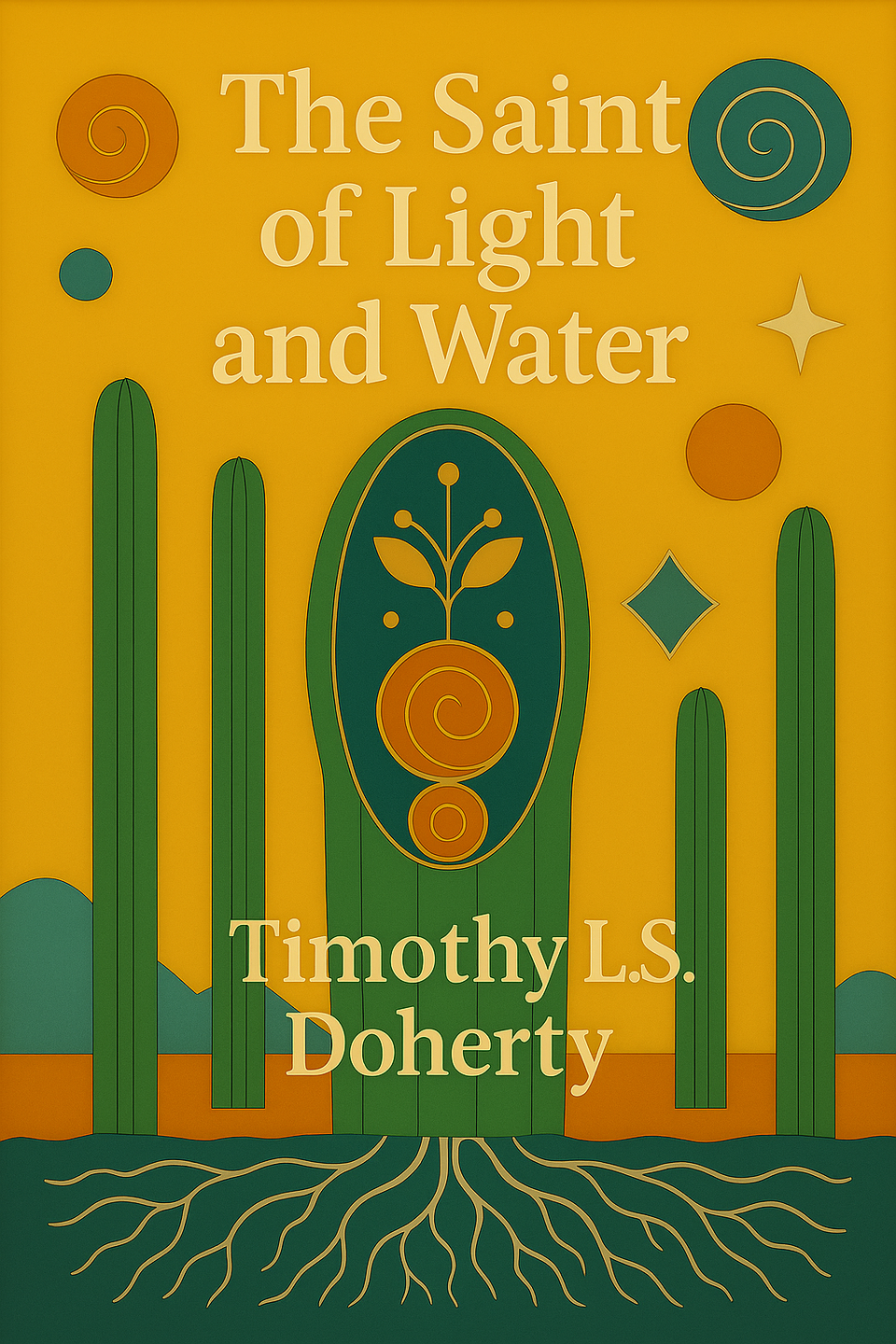
Prologue
The Saint of Light and Water is the record of an old medicine speaking through a new wound—an entheogenic element carried inside an eco-mythic story written for the healing of humankind.
The cactus around which our story is built first knew itself as Huachuma…the staff of vision tended by Andean curanderos for centuries.
Long before a single priest named it San Pedro, it was a bridge between breath and stone—a plant that remembered rain when humans forgot how to listen.
The Spaniards called it Saint Peter, linking it forever to the gate of heaven, and humankind responded by assuming it would deliver them to paradise.
The Quechua people of the Andes, where the cactus originates, simply called it teacher or Grandfather.
Because they knew the truth of the rift between man and earth.
Because the wound was never heaven’s to mend.
It takes very little logic, once that truth has been fully revealed, to realize that the gates of heaven are the last place one needs to be searching to repair our discord—and the ancestors recognized that.
The wound between earth and humankind was created by us.
It is ours to heal.
Our current climate crisis is not only one of spirit, but one of perception.
Somewhere between progress and forgetting, we lost the heart language of the old conversation.
We mistook that silence for victory.
But a true triumph is what happens when many beings find a rhythm that lets them all keep breathing.
Whoever speaks here speaks for all who remember.
The Saint of Light and Water remembers what I know to be true—not believe, but know.
The story ahead is a brief repair in the great exchange between matter and mercy, a little lantern lit to celebrate the moment when humans learned to listen again to the old conversation.
Mother Earth, patient as ever, replied.
She has never missed a beat.
She cannot.
For she is the pulse itself.
If huachuma is a teacher, its first classroom was the high Andean valleys of Peru and Ecuador.
For thousands of years it has grown on steep, stony slopes where clouds drag their bellies along the ridgelines, water is precious, and people learned to listen very carefully to both.
Traditional huachuma practice grew up in and around worked landscapes: terraces, irrigation canals, and smallholdings where water was directed with intelligence, and never wasted.
San Pedro is a highland cactus, not a lowland furnace cactus. Its architecture—tall, fast-growing columns with relatively thin skin—makes sense in places with bright light moderated by altitude and clouds, regular moisture pulses, and mineral soils that drain fast but still hold a trace of memory.
Far from those valleys, another hill has begun to answer to that same pattern.
Granada’s Costa Tropical is one of the very few places on earth where the cactus and the climate can meet on something close to equal terms: a subtropical outlier held between sea and mountain.
Granada boasts more than three hundred days of sun a year, winters gentle enough that frost forgets to come all the way down to the terraces.
Old acequias and gravity-fed channels still move water across our slopes the way Andean canals once did—arriving in pulses, not in floods, then slipping away so roots may drink without drowning.
It is a blessed ecology.
It is one honest glimpse of how mankind and Mother still tend to each other.
Most of my conviction about this coast doesn’t come from maps or climate data, or even the beautiful life it has readily given my family.
It comes from walking the seam where river, sea, and hill politely, and with a noble dignity, draw flexible terms with each other that allow for everyone to prosper.
You can start at the mouth of the Guadalfeo where it loosens into the Mediterranean—brown river folding into blue water. From there, if you follow the coastal camino on foot instead of by car, the story changes in small, steady increments: concrete to scrub, scrub to terraces, terraces to ravines and limestone cliffs that still remember what wild meant.
That still remember their old home at the bottom of the sea itself.
Somewhere between Motril and the first hard rise of the Alpujarras, you’ll start seeing the columns if you know where to look.
Not in curated shrine gardens, but in the background of actual work: a stand of pachanoi holding the corner of a mango terrace; a single old column leaning against a whitewashed caseta, ribs scarred from some forgotten storm; a row of rooted cuttings marching up a new bank where somebody decided erosion control and devotion could be the same job.
Further up, where the track turns to ruts and the wind comes straight down through the barranco, you find the men and women who keep those columns standing.
They don’t look like “plant medicine facilitators.”
They look like what they are: small farmers and peasant engineers in sun-bleached straw caps and Barça shirts from three seasons ago.
One hand on a saw, one hand on the trunk, talking to the cactus in the same half-muttered tone they use for their dogs and their tractors and the other things they respect deeply.
The cutting itself is never casual.
There’s always a pause—eyes up to the sky, across the slope, down toward the tank that’s already lower than they’d like. Only then do they lean in and start the teeth moving.
A length of cactus lets go with a soft, fibrous sigh and suddenly there is a question lying on the ground: roots or medicine?
Either way, the next move is patience.
The fresh-cut column doesn’t go straight into a pot or a brew. It gets laid gently on old boards or pallets in the shade, callus-side up to the dry air.
A week, two weeks, sometimes more—long enough for the wound to harden into something that can face soil again without rotting.
In that limbo, men walk past it with hoses and buckets, checking with the back of one knuckle the way you’d test a loaf of bread: is it ready yet?
When it is, the choreography shifts uphill.
On a south-facing terrace above Ítrabo or Vélez, a chestnut stake goes in first—driven deep into rubble soil made of broken ceramic tiles, river stone, and a century of fallen leaves.
Two men lift the column together, arms locked around spined green weight, and lean it into the stake until cactus, wood, and hillside find a shared center of gravity.
Strips of old irrigation hose or soft rope bind them together. The tie is never tight enough to bite, just firm enough to stand against the Levante when it comes screaming down the ravine at three in the morning.
It looks simple.
It isn’t.
Every decision—where to cut, where to root, how high to stake, how tight to tie—is a negotiation between plant, slope, and water that you cannot learn from books alone.
It’s tacit knowledge: the kind you do with your hands and your lower back, not with a survey.
From the outside, it might look like propagation for retreats.
On the ground, it’s older than that. It’s the same terrace logic that once kept wheat and olives and mulberries alive up here, now extended to a highland cactus that has proven it wants to stay. It wished to make a home here and thus, it did.
The men who do this work are not Andean curanderos.
They don’t pretend to be, and we shouldn’t pretend for them.
But they are, in a very real sense, the plant’s first line of priests on this coast: the people who decide where it stands, how it survives the winter, and whether it snaps or flexes when the next big wind comes.
The Andes will always be the original covenant. But if you stand on a south-facing terrace here at dusk—cactus ribs catching the last light, mango leaves sighing, avocado slowly ripening and the acequia whispering below—you can feel that the contract has been extended and resilience already achieved.
Not replaced.
Not copied.
Just continued, in a new dialect of the same old sun and the same ancient conversation.
In these pages, the San Pedro cactus carries its quiet gospel of light across oceans and empires, teaching that endurance—rightly understood—is a form of prayer.
If you read slowly enough, you may hear it breathe:
consciousness was never meant to belong to one species alone.
The Universal Sound that binds us all forbids exclusivity and insists on balance—
the kind that lets stone, bird, and human share the same weather without canceling out each other’s song.
This offering, left humbly in your keeping, is not a tale of escape…but a record of return.
The old medicines—especially Huachuma—do not open heaven;
they polish the hinge between worlds…
they shine the rusted gate between the seen and unseen.
They open the head and allow the heart to lead a conversation with the land. It is in this process that the human heals.
They remind us that perception, when tended, becomes devotion,
and devotion, when practiced, becomes repair.
If we learn again to hear the hum beneath our own noise,
the earth will not need to save or forgive us.
She will simply reach out,
take our hand,
and lead us home again.
This is a story about remembering how to listen.
Its medicine is not offered as doctrine or cure,
but as a metaphor for humility.
Every living thing carries instructions for balance.
The only question is whether we can still slow down enough to hear them.
What follows is not defense, nor sermon—
only a remembrance of the old conversation between the human heart and the breathing earth.
If it stirs anything in you,
let it be gentleness.
Selah.
Timothy L.S. Doherty
Ítrabo • Al-Andalus • España • Planet Earth
Chapter 1 -
Granada, 2045 – The Fever and the Letter
The world had tipped into its fever.
The air over Granada smelled of ozone and diesel, last perfumes of a civilization that had forgotten how to heal itself. Power grids flickered like uneasy conscience. Markets forgot how to count. Governments forgot how to listen. Rivers forgot how to rise.
Spain had shrunk to a whisper of its old population. Outside the walls, the Islands floated in manufactured comfort. Above even them, three million souls labored on Mars.
They had been promised a pure future and then handed a shovel by the same cabal that controlled the drones.
From the top of Cerro del Sol, all of that looked very far away.
Inés Lázaro walked before dawn because sleep had learned to avoid her. The climb from Sacromonte to the old Moor’s Chair had become her one non-negotiable ritual, a way to remember her body still knew how to move forward even when the world did not.
The trail wound between scrub and stone, the city dropping away behind her in stages: cave light to streetlamp, streetlamp to dull orange haze, haze to the low metallic glow of a grid on life support. By the time she reached the ridge, her breath came in soft clouds, ghosts fleeing her mouth.
She stood where queens once watched first light comb the Sierra and set her boots wide on the cracked stone. The Alhambra’s red bones caught the thin suggestion of dawn, bruised and beautiful. Below, Granada lay like a sleeping animal that had been shaved and marked for surgery.
The Darro whispered through its narrow gorge, mostly memory now. The Genil was a thin, dark thread at the edge of the city, a vein on the back of an old hand. From up here, she could still pretend the fountains were running.
It was a lie, but a kinder one than most.
Children below learned constellations from the drones that patrolled the night. The real stars had long since disappeared behind the brass-colored sky, their myths traded for ration codes and production quotas. Drones were the new firmament, and everybody knew they didn’t grant wishes.
They did deliver other things.
She wrapped her coat tighter against the mountain wind. Somewhere above, she caught the faint hum of rotors.
Inés went very still.
Drones could find anyone, anywhere. They were half postman, half angel of judgment. A drone at your door might mean a ration notice, a summons, or a one-way boarding pass to the Red Planet.
She had watched a neighbor taken that way once, arms pinned in a harness of light while the machine read out his “selection score” in a cheerful, neutral voice. He had not resisted. There wasn’t anywhere left to run to.
The hum grew louder, circling, then steadied.
“Not today,” she whispered, not sure if she meant it as a plea or an order.
The drone slid into view over the ridge, a dark insect against the brightening sky. Its searchlight remained off; only a small green diode blinked at its belly like a slow heartbeat. It dipped once, locked onto her, then hovered at eye level, close enough that she could see the dust on its housing.
“Inés Lázaro,” it said, voice filtered through the same calm chip they used for announcements at ration kiosks. “Identity confirmed.”
Her stomach dropped through the rock.
A compartment opened with a click. A thin metal capsule dropped toward her on an accordion of flexible tubing, like the throat of some mechanical bird. It stopped a hand’s breadth from her chest and waited, humming softly.
“Certified correspondence, extra-planetary origin,” the drone intoned. “One of one. Annual allotment satisfied for cycle of one Diego Borrego Lázaro of Level 9/Tier 3 Hydroponic Plant/Mars Colony.”
Her throat tightened.
Only one person off-planet had the right to send her anything.
She took the capsule. It was colder than the wind. The drone retracted the tube, gave a small, almost apologetic shudder, and rose.
“Gloria a la Humanidad Unida,” it said, the old slogan sounding ridiculous in the thin air.
Then it lifted away, back toward whatever invisible grid had sent it.
For a while she just stood there, the capsule heavy in her palm, listening to the hum fade into the wider silence. Her heart pounded so hard it made the metal tick against her skin.
She didn’t open it right away.
Below her, the city began its slow imitation of waking. A single tram coughed into motion near the old station. Lights flickered in the Albaicín, then thought better of it and went out again. The Alhambra sat in its own shadow, a patient red animal waiting for a verdict that never came.
Inés sat on the worn stone of the Moor’s Chair, legs drawn up, capsule between her knees. The last time a letter had come, it had taken her three days to break the seal. The words inside had not waited; they had lived in her chest the whole time, sharp as unpulled glass.
The last letter had been from the Mars Colony as well, informing her of the death of her father “in the name of la Humanidad Unida.”
She pressed the capsule’s seam with her thumb.
It hissed softly and unfolded, metal petals peeling back to reveal a thin scroll of recycled fiber, rolled tight as a vein. The paper smelled faintly of iron and something chemical she could not name. The ink, even from here, carried a shade of red she did not trust.
Her brother’s handwriting laced across the first line.
Her vision blurred.
For a moment she almost closed it again, slid it back into the capsule, and pretended the drone had never come.
But there were only so many times you could refuse to look directly at the thing you were already living inside.
Inés took a breath that hurt, blinked hard, and unrolled the letter with careful fingers.
What followed was the only voice of family the Red Planet allowed her, once a year, filtered through censors and quotas and whatever lies they needed to wrap the truth in to keep three million workers moving in circles.
She read every word.
Mars Arrival UPDATE –
Inés,
They started the videos as soon as the airship cleared the walls.
Big curved screens along the cabin, no way to look out, just “orientation.” Families in clean overalls walking under glass domes, kids chasing a dog in slow motion, everyone laughing around tables piled with greens. A blond woman talking about “the New Covenant of Work and Reward” in that voice they use for medicine ads.
Every few minutes they cut to a shot of the Islands from orbit. All that glass and white metal floating in blue.
“Together,” the caption said.
I remember thinking: together with who?
The kid in the bunk above me whispered, “Looks nice, no?” through the webbing. He couldn’t have been more than seventeen. Red Contract still creased at the edges of his armband. His wrist flashed green every time the presenter registered his enthusiasm for the opportunity.
They kept the lights low, so you couldn’t see how many of us were crammed in. You could smell it, though. Nerves and cheap soap and the kind of sweat that only shows up when people have already sold their future.
We didn’t see a window until docking.
The videos cut out mid-sentence—woman’s teeth frozen on the word prosperity—and suddenly there it was through the porthole: not a silver city, just a dark knot of modules bolted together over rust-red rock. No sky, just metal and dust and a halo of debris turning slow around the hub.
Nobody said anything. You could feel the hope deflating, but nobody wanted to be the first to puncture it.
“This must just be intake, I thought.” I could see it was not only my face that bore the wrinkled brow of distrust.
The ramp down from the shuttle was steeper than they showed us in recruitment. The gravity’s wrong here, just enough off to make you clumsy. People stumbled. The guards didn’t.
They were waiting at the bottom of the ramp in matte helmets, visors down. No faces, just mirrored strips and numbers on their chests. Behind them, through the choke of red dust, I could see the domes from the videos—only from this side you notice the fences, the watchtowers, the way the lights never go all the way off.
They ran us into two lines with batons and boots and a pack of robotic dogs that didn’t bark, they just watched.
Big screens overhead kept playing the same loop they’d shown us on the way up: kids in gardens, fake sunlight, someone biting into a tomato like it was a sacrament.
The man in front of me turned his head, just a little, trying to look past the guards at the green he thought he saw behind the fences.
The nearest helmet stepped in and cracked him across the face without even breaking stride. Short move. Practiced.
That was the moment I was sure.
I heard the sound more than I saw it—wet and sharp, like someone snapping a branch that wasn’t fully dry. He went down on one knee, blood already sliding off his chin onto the grating. Nobody stopped to help. We’d all read the fine print: helping someone else is clearly marked as “obstructing operations.”
When it was my turn at the scanner, the guard’s gloved hand shoved my jaw to the side, fingers digging into the hinge. Checking teeth, maybe. Checking compliance.
“Worker unit,” the console said when it finished reading my band. “Greenhouse Tier 3. Productivity debt: ten years. Review at seven, subject to yield.”
I said, before I could stop myself, “I thought we were citizens.”
Helmet turned.
Just the faintest tilt.
“You’re staff,” a voice said from inside, flattened by the speaker. “The Citizens are on the Islands.”
Something in me wanted to spit. Something smarter didn’t. I just swallowed and tasted metal.
They marched us past the first dome. Through the glass I could see the rows of lettuce and zucchini, tomatoes and grapes… waist-high and neat under strips of artificial sun.
Above them, in the corner of the dome, a flag with a logo I recognized from ration crates back home.
The announcer on the overhead screens kept talking about feeding Earth.
But the manifests scrolling along the bottom told a quieter truth if you knew how to read them: Island codes, priority routes, export volumes.
None of it was going to those outside the walls. Everything was shipping to the Islands.
They took our bags.
They took our names and turned them into numbers.
They gave us new uniforms and old boots and a shift schedule printed on recycled plastic.
Twelve hours under the lights, six hours off, repeat until your body or your contract breaks.
There was a mural on the mess hall wall—some propaganda painter’s idea of courage.
A worker holding a basket of greens up toward a stylized Island in the sky.
The caption said:
“From Your Hands to Their Tables: One People, One Future.”
I laughed when I saw it.
Couldn’t help it
That’s when the first guard hit me.
Don’t worry, I still have most of my teeth. The jaw will heal crooked, but my voice works fine.
I just wanted you to know, before the delays get longer and the messages start disappearing:
They lied about the sky, Inés.
We don’t see it.
We grow food we don’t eat for people we’ll never meet, on a planet we’re not allowed to touch.
If they offer you a contract, burn it with whatever real flame you can still find.
Stay with the rivers, even if they’re sick.
Stay with the paper and the old men at the café.
At least there, when the world falls apart, you can see who’s holding the hammer.
— Diego Borrego Lázaro
Level 9/Tier 3/Mars
By the time she reached the last line, her hands were shaking.
The letter ended, but the voice did not. It kept speaking inside her in the gap between each heartbeat, in the white space after the signature, in the neat little production slogan they’d forced him to copy at the bottom.
From your hands to their tables: one people, one future.
The words lay on the page like a bruise.
Inés rolled the letter back up with a care that felt like fury. She slid it into the inner pocket of her coat, close to the small Andean pouch that still held a pinch of soil, and pressed her palm over both until she could no longer feel which one was colder.
She did not scream.
She did not cry.
She sat very still on the Moor’s Chair, high above the thinning rivers and empty lots, and listened to the broken world breathe.
“Not yet,” she whispered to nobody and to everything. “You don’t get all of us yet.”
Only when the wind shifted and the first weak light of morning touched the distant Sierra did she stand, brush stone dust from her palms, and turn toward the path that would take her down past her old coffee shop El Calar, along the Río Genil, and back to the work of counting what remained in the name of the Junta de Andalucía, Humanidad Unida, Sector 7.
The river waited below.
It had things to say.
Chapter 2 -
Granada – The River Remembers
Before Inés, before drones, before walls and Islands and slogans, the mountains learned how to lift water into the sky.
The Sierra Nevada rose from collision and seabed, a heave of stone that once lay under salt. Layers of mud and fossil and pressure hardened into quartz and limestone and fractured granite. For a long time it knew only silence and wind.
Then came ice.
Snow settled into the high bowls of Mulhacén and Veleta, patient and heavy. Spring after spring, thin meltwater crept out from under the white, testing the slopes. Trickle learned ledge. Ledge learned ravine. Threads of water braided together, choosing paths the rock did not yet know it carried.
One of those threads became the Genil.
It began as a small, cold thought running over stone. It took the temperature of everything it touched: iron, lichen, the brittle roots of alpine grass. It folded other springs into itself, river by accretion, until it could feel its own momentum.
Before anyone named it, the Genil already understood its task.
High up, it moved fast and narrow, veining scree and dwarf pines. Lower down, where the slopes softened, it slowed just enough to start building banks, laying down fine mud and memory. A broad green valley gathered around that motion — the Vega de Granada, the river’s own garden, stitched out of centuries of silt.
The Vega was the handwriting of the river.
Each field — pomegranates and olives, rows of beans, fields thick and brimming with legumes and lettuce — was just another verse in a sacred correspondence, written in mud and blessed by an ever-present sun.
The bounties of the Vega were the rewards of an ancient covenant between those who tended her and the water the Sierra blessed her with.
From high points on clear days, before the sky turned to brass, you could trace the Genil’s journey: born in snowlight, green in pine shade, silver at the city’s edge, then she widdled her way westward until she surrendered to larger waters and eventually to the sea.
Other waters chose a steeper vow.
South of Granada the land buckled again into the broken amphitheaters of the Alpujarras and the smaller, more secret bowl of Los Guájares. There, rain and springs didn’t bother with plains. They plunged straight down through gullies and barrancos, racing toward the Mediterranean as if remembering their old home.
Those southern streams tore their way through slate and schist, collecting each other’s weight until they answered to a single name: Guadalfeo.
Where the Genil believed in distance and accumulation, the Guadalfeo believed in descent and arrival. It hurried out of the snowfields, took one deep breath in the tight valley above Órgiva, then cut its way past Los Guájares and the last patient mango terraces, loosening its mountain silt into the blue between Salobreña and Motril.
It was not alone.
The Verde slipped past Almuñécar, the Seco dropped toward La Herradura, the tiny Jate hurried under the bridge at Ítrabo, and a scatter of seasonal ramblas woke and vanished with each hard rain. Together they formed a small fraternity of falling water, all of them flinging what was left of the Sierra into the same narrow band of sea the maps called the Costa Tropical.
Between the two rivers, a whole province hung from the same spine of stone: Sierra Nevada above, Granada held in its lap, the Costa Tropical at its hem where land and sea negotiated every tide.
Those rivers carved more than scenery. They cut corridors — littoral pathways where birds, seeds, and people could travel between snow and shoreline without asking any government’s permission. Guájares valleys and Alpujarra ridges became the old arteries of movement, long before asphalt copied them in clumsy grey.
Even in fever years, rivers remember each other.
They remember in sediment and salt, in the taste of a certain mineral, in how wind funnels through a notch in the ridge. Somewhere in its thinning body, the Genil knew it had cousins that ran south instead of west. Somewhere in the deep stone, the Guadalfeo knew there was another river that carried the same snow toward a different fate.
Melt, fall, listen, feed, return.
It was that law Inés was walking inside every morning, whether she knew it or not.
By the time she came down from Cerro del Sol the day the letter arrived, the sky over Granada had shifted from black to tarnished silver. The first light behind Mulhacén etched the serrated edge of the range, making the snowcaps look closer than they ever were.
The trail unwound from rock back into city in stages: coarse gravel to carved steps, steps to the slick stones of the Camino del Sacromonte. Cave houses clung to the hillside, chimneys breathing out the last of the night’s woodsmoke. Someone’s radio murmured a half-hearted copla. A dog shook off sleep in a doorway and watched her pass with mild suspicion.
Down below, where the Albaicín fell away into the newer streets, the rivers met.
The Darro, thin from its run under stone, slipped out from beneath the old quarter and delivered what was left of itself into the Genil like an apology. Once, both rivers had run clear and fierce, white with spring melt and mountain story. Now the Darro arrived tired and stained, and the Genil — thin as a vein on an old hand — had to pretend it was grateful.
At the place where the embankment loosened and gave the water a little room, the café El Calar still held its corner.
It was nothing to look at: four chipped tables, a faded awning, a counter that had belonged to some richer bar in some other decade. But it sat exactly where the city began to remember it was not the whole world — that beyond the concrete and ration kiosks, the river still had its own life and destination.
That was enough to make it holy.
At El Calar, a café beside the Río Genil where the city gives way to the wild, a few old men still gathered under tattered umbrellas.
They stirred their coffee without drinking it, eyes following the river’s slow retreat.
It was rare for anyone to afford more than one cup of coffee a day now.
What they shared instead was silence, a common inheritance.
After weeks of watching the current shrink, they decided the Earth had begun its own revolution — silent, thorough, without slogans. Without propaganda. Without permission. The Mother, they said, no longer consulted with humankind. Her concern was life itself. If preserving life for the rest of creation meant losing one species, so be it.
Inés passed El Calar each morning on her way down from Cerro del Sol, the air thick with burned sugar and diesel — a civic incense that clung to everything. The old men no longer always looked up. Once she would stop and trade a few words; now conversation had thinned to the scrape of spoons and the slow surrender of steam.
Today they looked up.
“Buenos días, niña,” one of them said. Don Manuel, the one whose eyebrows could still manage indignation. His eyes flicked briefly to the bulge in her coat where the letter lay, then back to the river, as if he’d already guessed what kind of bird had brought it.
“Buenos días,” she answered. Her voice felt like it had grit in it.
The second man, with the faded Betis scarf, nodded toward the water. “Genil’s sulking,” he said. “Didn’t like the wind last night.”
“The river is not sulking,” said the third, El Tío, voice like gravel on tin. “She’s listening. Trying to decide if we’re worth the trouble.”
“Verdad que no,” Don Manuel muttered. “We already gave her the answer.”
They watched the current for a moment longer. A foam scrap spun in a slow whirlpool, unable to commit to downstream.
“You look thinner,” Betis said to her, not unkindly.
“Rations,” she said. “And insomnia.”
“Same thing,” he said, and went back to stirring his small, dark universe of coffee.
She could have stopped longer. Some mornings she did, letting their low commentary on the state of things hold her in place like extra gravity. Today the letter in her pocket felt like a stone that needed new shelves around it.
“Hasta luego,” she said.
“Si llegamos,” Don Manuel replied. If we get there.
The river moved under them, quiet and stubborn, carrying the city’s reflection toward places most of its citizens would never see.
Power rationing had dimmed the lamps along the Carrera del Darro to a single trembling filament, the kind of half-light that arrives before a city remembers it’s supposed to wake.
By the time she turned away from El Calar and followed the water toward the archive, streetlamps were blinking out in confused sequence. Some died all at once; others clung on in desperate flickers as if trying to convince themselves they still had a job.
Granada endured the fever the way most old cities do — by pretending it was passing weather, another plague that would leave the stones and take only the flesh.
Those who remained lived half underground, trading rumors for food and food for memory. The city had become an archive of gestures: hands passing water, doors closing softly, prayers muttered to the tap before turning it. The sound of running water was still a promise, and people kept their promises even when the pipes forgot.
Her day would be the same as the last: the long corridor of the municipal archive, bulbs trembling, air thick with old glue and decaying plaster. Shelves leaning like veterans, tagged with the names of the dead and the displaced. It was the Junta de Andalucía that signed her pay slips now, some division of Humanidad Unida that needed its losses counted.
Her work kept her fed, and in return she was expected to keep the records breathing — to name the dead as they vanished, to number the rations, to make the loss legible.
But that was for after the river.
She paused at the low wall and pressed her palm to the cool stone, feeling for the faint tremor of the current below. The Genil answered with a thin, insistent pulse, like a heart working too hard for too little blood.
“Stay with the rivers, even if they’re sick,” Diego had written.
She let her hand rest there a moment longer than usual.
By evening, when the archive had given her all the dust it had to offer for one day, she climbed back toward Sacromonte.
The city’s power allotment for the night had already been spent on hospitals and grid fences. Streetlights failed quietly, one by one, until only the last window-glow and the nervous sweep of drones remained.
Her apartment in Sacromonte was the size of a confession booth — one bulb, a chipped basin, a single window facing west toward the Alhambra’s dark silhouette.
When the power failed, the caves around her glowed with candlelight, older than time, as if the mountain itself were remembering fire. Light seeped out of doorways and cracks in the rock, a constellation closer and more stubborn than the one that had vanished from the sky.
On nights like this, Sacromonte looked like the inside of a sleeping animal’s ribs, as if the illuminated soul of the land had seeped through rock and soft sediment to offer a little comfort to the humans still humble enough to recognize the gift.
She set her satchel down and crossed to the window. The Alhambra’s outline sat black against the dim halo over the city, its towers glinting faintly where some emergency light caught old tile. Once, buses had clogged the lots and narrow streets busked with the commerce of wonder and the zapateo of flamenco dancers. Now the fortress watched over empty parking lines and ration queues.
She kept three possessions on her windowsill: a cracked cup for water; a small woven pouch from the Andes, heavy with a pinch of soil; and a river stone lifted from the Genil the day its current slowed to a whisper.
Each was an instrument of faith.
The cup reminded her that a wounded vessel can still hold what matters.
The pouch had been a gift from a Quechua woman in her grandfather’s home valley, the year he finally took her back to trace the mountains he had carried inside him to Spain.
Her abuelo had slipped between Spanish and Quechua when he was tired, the old syllables leaking out in kitchen prayers and terrace songs, but it was this woman — his cousin, older than both of them put together — who placed the pouch in Inés’s hand at dawn and made the lesson plain.
She had taught her to listen to the ground before planting anything — especially a thought, the woman had said. Inés had tried to live by that counsel ever since: listen before building; root each act in silence.
She remembered the woman’s open palm, the puff of breath as she blew soil and mapacho smoke into morning mist — an offering to Pachamama, not a goddess but the living total of earth, sky, water, and time.
“She is not above you, hija,” the woman had said. “She is beneath, around, and through you. Someday she will call on you. This is written already.”
It had sounded like myth then.
She reached into her coat, took her brother’s correspondence, and slid the rolled page into the cracked cup until it rested against the inside curve like a new, fragile bone.
Now, with a Mars letter listening beside river stone and Andean soil, and the Genil thinning below her feet each day, it felt less like memory and more like a summons — not only for her, but for whatever thin hope might still reach as far as the greenhouses on the Red Planet.
Next she took up the river stone. It fit her palm perfectly; she closed her hand until the day’s ache gathered there, letting the cool weight draw it out of her fingers and into the old river sleeping inside the rock. When she lifted it to her temple, the stored chill moved into her skin, a slow, deliberate current that cooled her thoughts and steadied her pulse. For a moment she could feel the circuit complete: pain leaving through her hand, water returning through her brow, her heart quietly taking up the rhythm.
Cup, pouch, stone — three small anchors on a narrow sill, the closest thing she had to an altar in a world that had forgotten how to build them.
She tapped the stone once against the rim of the cup and set the pouch between them, a small triangle of earth, water, vessel.
Outside, the caves flickered. Somewhere deep in the hillside, a voice older than the rock itself began to sing without accompaniment.
Sweet and low, she heard the words “Pachamama” and “medicina” slip through the thick cave walls, drifting through the thin stucco of her flat.
On the shelf above her bed, under a stack of unpaid notices from the Junta, lay a different kind of inheritance: a yellowing folder stamped MONTE PHILLIPPE – ÍTRABO, PROPIEDAD RÚSTICA.
Her great-grandparents’ forgotten cortijo, or what the state still insisted on calling one.
Mango and avocado plantation, according to the last assessment; terraces held up by old stone and stubbornness; a farmhouse that official letters described as “in need of modernization,” which meant it still knew how to breathe without machines.
She had not been there in years.
There were always better excuses to stay in the city and count the dead.
Tonight, with Diego’s words still echoing behind her eyes and the weight of the river in her hand, the idea of a house hanging above another river, somewhere between the Sierra’s snow and the Mediterranean’s salt, did not feel like nostalgia.
It felt like direction.
She blew out her candle and let the mountain’s scattered lights, and the soft singing of that unknown-yet-familiar voice, permeate the apartment like a lullaby, carrying her down into dreams that could resolve what daylight and its tasks could not.
Below, under stone and concrete and policy, the Genil kept moving toward its own appointment with the sea.
It had things to say.
Soon enough, if anyone was listening, it would start saying them out loud.
Chapter 3 – Grandfather Without a Watch
Sleep took her sideways.
One moment Inés was lying on the narrow bed in Sacromonte, listening to the last notes of the song seep through stone. The next, the ribs of the sleeping animal that was the hillside stretched and breathed, and she was moving inside another body altogether — nestled in the earth, wrapped in a blanket of moss and memory.
The first thing that changed was the air.
Granada’s winter-dry chill thickened and warmed, edged with the smell of eucalyptus and woodsmoke and something sweetly green she had not tasted in years. The second thing she noticed was the sound of water.
The Genil, boxed in by culverts and ordinance, thinned and brightened into a river that spoke in a clearer voice, stone against stone, meltwater over granite.
She stood on a path cut along a steep, terraced slope. The world fell away below her in a series of green shelves and silver threads: maize and potatoes, narrow fields held in place by walls of stone fitted so tightly no mortar dared come between them. Far below, a larger river curled like a dark rope through the valley, catching pieces of sky in its turns.
Above, mountains rose in long, patient lines, their flanks scored with old landslides and cloud shadows. Snow sat heavy on some of their shoulders, bright even in the diluted dusk.
She knew this place.
Her body went slack with recognition before her mind found the name. Valle Sagrado.
The Sacred Valley of the Incas. The valley her grandfather had called simply mi valle when he spoke of it, as if no others existed.
The path under her boots was the one she had walked as a girl between his village and the river, still etched into the soles of her memory.
Someone was humming ahead of her.
The melody was the one that had risen from the caves of Sacromonte just before sleep claimed her—part lament, part lullaby, a tune that knew the weight of years. Here it came from a single throat, unamplified by stone, carried on the same thin air that smelled of damp soil and boiled maize.
Inés followed it around a bend in the path.
Her grandfather sat on a low wall, hat tilted back, ankles crossed. He was exactly as she remembered him in the years before the stroke: wiry frame wrapped in a cardigan too big for him, silver hair escaping under the brim, wrist bare where a watch should have been.
He had never worn one.
She remembered the other old men chiding him about that when she was young.
“How can a man keep track of things without a watch?” they would ask.
He’d smile softly and repeat the same phrase, his eyes reverently averted to the earth:
“Because the time is now.”
Time, he used to say, belonged to the mountains and the river. Humans were only borrowing it.
“Abuelo,” she said.
The word left her mouth in Spanish but landed in something older. He lifted his head and smiled, and in the curve of his lips she saw the same mixture of mischief and patience that had steadied her as a child when the world felt too large.
“Ah, mi Inesita,” he said. “Por fin.”
He patted the stone beside him.
She sat. The wall was cool and damp under her, the way stones that have held water for centuries always are. Below, the terraces stepped down toward the river in careful, human-made lines that somehow felt as inevitable as the mountains themselves.
“Am I—” She stopped. The question felt stupid even as it formed.
He saved her from finishing it. “Dream, waking, memory,” he said, lifting one shoulder. “The valley does not care which word you choose. You are here. That is enough.”
His voice was stronger than in her last real memory of him, less frayed at the edges. It carried a rhythm that matched the river’s, a slow insistence.
“You look the same,” she said.
“You look tired,” he answered, and his eyes softened. “Too many ghosts in your boxes. Too much counting of other people’s endings.”
She huffed a breath that was almost a laugh. “That is the job.”
“Jobs change,” he said. “The valley does not.”
He swung his legs down from the wall and stood in a single smooth motion she did not remember him ever managing in Granada. As he rose, little details shifted without quite drawing attention to themselves. The cardigan straightened into a woven jacket, dark wool shot through with colored thread. His worn city shoes darkened into old leather boots stained with earth and river silt. The hat stayed the same, but it sat differently, as if remembering a younger skull.
“Walk with me,” he said.
She did, because she always had.
They moved along the contour of the slope, the path narrowing in places to the width of a single foot. On the uphill side, stone walls rose to hold back the terraces above; on the downhill, others fell away to cradle the fields below. Whoever had built them had known exactly how much weight water and soil could carry and where they would try to escape.
The air was full of small, busy sounds: the rustle of leaves, the soft clink of a distant bell, a woman’s laughter carried up from somewhere invisible. The river’s voice underpinned it all, a low, constant conversation that had started long before either of them were born.
Something moved on the path ahead: three quick flashes of rust and shadow.
Foxes.
They paused just long enough for her to catch their outlines—lean bodies, dark legs, tails writing questions in the dust—before slipping off between the terraces and vanishing into fennel and stone.
“You saw them,” her grandfather said, not quite a question.
“The foxes?” she asked.
He nodded. “Nietos de Trueno,” he said. “Grand-cubs of Thunder. They kept me honest here. Still do, when they feel like it.”
“Thunder is just the sky remembering it has a spine,” he added. “Storms are how the world clears its throat. Don’t forget, Inesita — you’re my granddaughter too. You were born to carry a little of that noise, as long as you spend it in the service of rain.”
As they walked, she watched the hillside for another glimpse, but the only trace of them was the occasional paw print in the damp earth and a faint, wild musk that rode the wind in small, teasing currents.
She glanced at her grandfather.
Step by step, his body seemed to be shedding years. The stoop left his shoulders; his gait lengthened. The blue veins on the backs of his hands faded to a firm, sun-browned skin that knew tools. The deep lines around his mouth smoothed into something more purposeful, less apologetic.
“Are you—” She tried again.
He smiled without looking at her. “I am myself,” he said. “Just from a different page.”
They rounded another bend.
That was where she saw the cactus.
It stood at the corner of a terrace, three tall columns of green rising from a base half-hidden by maize. Ribs ran up its sides, casting narrow shadows. It was not huge, not the kind of cathedral specimen tourists posed with, but it was old enough that its skin carried scars: a healed cut here, a lightning-mark there where something had fallen against it.
The sight of it hit her in the chest.
Huachuma, her mind named it, with a clarity that surprised her. Grandfather. Staff of vision. Teacher. Names she had heard ages ago, whispered in the valley wind, now stood before her in living flesh.
Her grandfather paused and touched his fingers lightly to one of the ribs.
The spines were short, far less inclined to pierce a man’s finger than to attempt to open his heart.
His gesture was reverent without being theatrical, the way someone might greet an elder they saw every morning.
“The cactus knew itself here before we had words for it,” he said.
“We just learned to listen, and it taught us how to answer.”
She watched his hand rest on the plant. The contact seemed to complete a circuit between soil, flesh, and stone.
The river below thickened its voice for a heartbeat, as if acknowledging the touch.
“Abuelo,” she said. “Were you… a curandero?”
The word felt too large and too small in her mouth at once. In Granada, it had been a term she rolled around in her head when she read about Andean healers in books or heard stories half-whispered in kitchens; here, it felt like a name that had always been his.
He let his hand fall away from the cactus and resumed walking. For a while, he did not answer.
“At home, in Granada,” he said eventually, “I was an old man without a watch who told you stories and slept in a chair. That was true. Here, before they took my papers away and gave me new ones, they called me something else.”
He glanced at her, eyes glinting.
“A curandero is not a magician, niña. We are the clerks of the old conversation. We remember which questions belong to which part of the land.”
They came to a narrow stone channel running across the path, an acequia no wider than her hand. Water slipped through it in a clear ribbon, diverted from the larger river below.
He crouched and tapped one of the small rocks that braced its side. It shifted obediently back into alignment, tightening the flow.
“You see this?” he said. “Everyone walking past thinks it is just water in a ditch. But if this stone moves too far, the field below starves and the one above floods. My work was to notice which stone was tired, which one was ready to carry more weight, which one needed relief.”
He straightened up.
“Sometimes the question was a fever in a child,” he continued. “Sometimes it was a drought that would not leave. Sometimes it was a man who wanted to stop hearing the voice of his own grief. The plant, the water, the mountain—they all had answers. My job was not to command them. It was to introduce them properly to whoever needed to listen.”
A flicker of movement drew her eye downslope.
One of the foxes had reappeared on a terrace wall, watching them with narrow, intent eyes. Its ears were pricked, its body still, as if it were listening to the same lesson.
“They helped,” her grandfather added, noticing where she was looking. “They brought me problems the way other people bring gossip. Once they dragged a gourd to my door because a boy had fallen in a storm. Another time they turned up with a broken bird. They do not speak in words, only in urgency. When foxes come to you wet to the chest, you follow.”
“Did you save them?” she asked.
“The boy?” He smiled faintly. “For a while. Long enough to give him back to his goats, and to the road that was waiting for him later. The bird learned how to fly wrong but still land with grace. That was enough for both of us.”
The fox blinked, as if satisfied with the accounting, and slipped away again. Foxes answered to the slightest change in the seen and unseen at once; no one could ever say exactly what called them. Her grandfather’s face held only a quiet assurance that he would return whenever the valley required assistance.
A long silence stretched between them, but it was not empty. The land filled it: birds calling from invisible perches, the rhythm of distant hoes in soil, the breath of the river.
“You left,” Inés said finally. “You came to Spain.”
He nodded, not defensively, simply acknowledging the fact.
“I did,” he said. “War, hunger, promises. You know the story they tell about why we leave. Some of it is even true.”
He stopped at another turn in the path. From here they could see further down the valley: more terraces, more scattered houses, the glint of tin roofs among the older thatch. Far off, a road cut across a slope in a straight, arrogant line.
“When I left,” he said quietly, “I told myself I was taking the medicine with me. That I was carrying something sacred to a new place, like a pilgrim with a relic. That was the story that let me put one foot in front of the other.”
He looked down at his hands.
“They call us healers,” he went on. “They forget we can wound as well.”
He did not make her ask.
“There was a man,” he said. “He came to me with a sickness that did not sit in his blood or his bones. It sat here.” He tapped the side of his head, then his chest. “He said he wanted to stop thinking. To stop feeling the weight of what he had done.”
Inés felt the skin on her arms tighten.
“I told him the plant does not erase,” her grandfather said. “She reveals. She opens a door between what you have buried and the place where you still remember how to be honest. He nodded. He said he understood. He did not.”
He drew in a breath that sounded heavier than the altitude should allow.
“I gave him the medicine anyway,” he said. “Because I wanted to believe him. Because I was tired and proud and I thought I could guide him through it. He drank. He saw what he had done when the river and the mountain took his story and ran it back across his heart. And then, instead of listening, he ran. He ran deeper into forgetting. He hurt more people with the clarity I had given him.”
Wind lifted a strand of white hair from under his hat. He did not seem to notice.
“I healed his fever,” he said. “I broke his mind’s fever, too. But I did not heal the land that had to absorb the consequences when he refused to change. That debt stayed. It still sits in the soil, in the way certain places go quiet when you walk through them.”
His eyes met hers.
“That is the crack in my halo,” he added, mouth twitching. “I misjudged a man’s willingness to listen. The plant did her work. I did mine badly.”
He turned away. They resumed walking.
“That was when I started to understand,” he said, “that my job was not to give the medicine to everyone who asked, but to guard it from those who would use it as another weapon against themselves and others. To decide who was ready to sit with what they would see.”
“And then you left,” she said again, more softly now.
“And then I left,” he agreed. “I told myself I was carrying the listening to another shore. Some nights, especially in Granada, I wondered if I had simply run away from the debt.”
They rounded another turn in the path.
The terraces opened into a small, natural shelf of stone jutting out above the valley. A spring bubbled from a crack in the rock at the back, falling into a shallow basin no bigger than a cooking pot before spilling over and wandering down toward the fields below in a fine, silver thread.
Someone had taken the time to clear the stones around the basin and lay a simple woven cloth on a flattish rock beside it.
It was not an elaborate mesa by any ritual standard. There were no candles, no statues, no sand mandalas. Just three objects laid out with the kind of attention that does not need ornament: a river stone, smooth and dark; a folded piece of old paper; and a small cactus cutting, no longer than her forearm, resting on a scrap of burlap.
Her grandfather stepped toward it with an ease that said this was a place he knew well.
“This is where I come when the dead are too loud,” he said. “Or when the living are too quiet.”
He touched the stone first, then the paper, then the cutting, a brief, respectful contact each time.
“This is a mesa?” Inés asked, voice low without quite knowing why.
“It is a table,” he said. “Like any other. It is only who sits at it and what is asked that makes it sacred. Sit.”
She sat on the opposite side of the rock. The river below seemed closer from here, its sound rising through the ribs of the hill. She could feel the spray from the little spring on her face when the wind shifted.
Something rustled behind her.
She turned her head.
All three foxes had gathered at the edge of the clearing, just beyond the cloth’s border of respect. They settled on their haunches in a neat row, tails curled around their paws, watching with the grave attention of creatures who have seen this done many times and are taking attendance.
Her grandfather picked up the folded paper and turned it over in his hands.
“Do you remember the pouch on your windowsill?” he asked. “The one my cousin gave you at dawn.”
“Of course,” she said. “I just—” She stopped herself. “I just put Diego’s letter beside it.”
He nodded, as if this answer did not surprise him.
“The women in my valley know how to make words last on paper,” he said. “They also know when not to trust paper at all. Ink fades. Pages burn. Colonizers rewrite. So some stories we sent forward in other ways. Rooted in plants. Carried in stones. Hidden in ledgers that smelled like sea and dirt and medicine at the same time.”
He laid the paper back down between them.
“This is one of those ledgers,” he said. “Not the one you will touch with your waking hands, but its echo. Its shadow.”
Her heartbeat stumbled.
“You are going to receive something tomorrow,” he said. “In the house where you keep other people’s stories quiet. They will bring you a box that looks like trash. It will stink of rust and salt and an old sickness that has not yet been named in your time. Inside there will be paper and wood and a piece of cactus that has crossed water and war and greed.”
He looked up at her, and for the first time since she had seen him on the wall, his eyes held no humor at all.
“You do not have to open it,” he said.
The words struck her like a slap.
“What do you mean?” she asked. “Of course I do. It’s my job.”
He shook his head.
“Your job is to count and to file and to keep the dead in their proper boxes so the living can pretend they will be remembered,” he said. “This is not that work. This is older. This is heavier.”
His hand moved to the stone. He placed it in her palm.
“You can turn away from it,” he repeated. “You can send it to storage. You can mark it for deacidification and let it die slowly under fluorescent lights. You can tell yourself the world is too broken and you are too small and that nothing you do with your two hands in that archive will change the fact that your brother is growing food he will never eat on a planet he is not allowed to touch.”
The stone was cool and rough. It felt like the one on her windowsill, but larger, as if it contained more river than any single hand could bear.
“And if I don’t?” she asked.
“Then you are taking on my debt,” he said simply. “And his. And the ones who carried the ledger before him. You are agreeing to let a living thing change you before you try to use it to change anyone else.”
He gestured to the cactus cutting.
“This is not a ladder to heaven,” he said. “You know that already. Nor is the book a key to some door that will swing open and fix everything because you read the right words in the right order.”
He picked up the cutting with both hands, careful of spines that seemed half metaphor, half real.
“Medicine like this does not open gates,” he said. “It polishes hinges. It reminds the door that it was made to move.”
One of the foxes yawned, sharp teeth flashing, then laid its head on its paws again, as if it had heard this explanation before and approved of it.
He set the cutting back down.
“The ledger you will meet,” he went on, “is a record of how one piece of this plant learned to listen across ocean and empire. It is a map of a conversation between land and people that almost died and did not. It is not neutral. It has teeth. It will bite through lies you are still using to get out of bed in the morning.”
A memory rose unbidden: Diego’s words on the page that morning—From your hands to their tables: one people, one future—and the taste of metal in her mouth when she read them.
“What if I am not ready?” she asked.
He smiled, but there was nothing indulgent in it.
“Nobody is ever ready to listen the first time,” he said. “You think I was? I told you about the man I hurt. Readiness is not a feeling. It is a decision to stay when the story begins to show you yourself.”
The river stone in her palm seemed to hum.
Below them, the valley darkened in increments as the sun slid behind one of the higher peaks. The terraces caught the last light in narrow bands: here a field gone briefly gold, there a waterway turned to quicksilver, then darkness again.
“And the others?” she said. “The ones on the Islands. On Mars. The ones who left the rivers.”
“The ledger is not for them first,” he said. “It is for the places still carrying enough water to remember themselves. Your brother knows that. That is why he told you to stay with the rivers, even if they are sick.”
He reached across the rock and took her free hand.
“The ones above you—on their glass boats and their red dust—are not outside the story,” he added. “They are just further along in their forgetting. If you do your work well, if you let this book and this plant change the way you walk in your own valley, the signal will reach them eventually. It may be in the taste of a tomato they cannot explain. It may be in a rumor that the rivers came back somewhere they had written off.”
He squeezed her fingers.
“But that is not your job today,” he said. “Your job is to decide whether you will open a box and let it rearrange your heart.”
He let go of her hand and sat back.
Wind rose along the slope, lifting the edge of the mesa cloth, ruffling his hair, carrying with it a thread of cold that did not belong to this altitude.
The Genil, she thought, without knowing why.
“Abuelo,” she said. “Why me?”
He snorted softly.
“You think I had a menu?” he asked. “I am dead, Inés. We have limited options for delivery. I chose the one person I knew who still touched the river every day and still believed in paper.”
A reluctant smile tugged at her mouth.
“You are an archivist,” he said more gently. “You know how to carry other people’s stories without making them completely about yourself. You know how to listen to the dead without letting them swallow you. That is rare. That is the curandero’s work, too, just in a different building.”
He nodded toward the spring.
“Also,” he added, “you are stubborn like your grandmother. And you still talk to stones. That helps.”
She remembered standing on the wall above the Genil that morning, palm pressed to cold rock, listening for the faint pulse of water below.
One of the foxes shook itself and trotted closer, stopping just short of the cloth. It sniffed the cutting once, then the stone in her hand, then looked up at her with an expression that was not quite approval and not quite warning.
“They will help carry it again when the time comes,” her grandfather said. “They have a talent for putting medicine on the right road. Once they took a wrapped cutting all the way to the docks, found a boy whose fear smelled like the hillside after rain, and sat on his chest until he said yes. But that is another chapter.”
The fox flicked its ears as if to confirm and returned to its place.
“What if they try to take it from me?” she asked. “The Junta. Humanidad Unida. Whoever decides which stories are allowed.”
He looked at her with something like pride.
“Then you will have to choose which law you answer to,” he said. “The one written by men who think they own the future, or the one written by rivers and mountains and old women with smoke on their hands.”
He lifted the paper from the mesa again and held it out to her.
“You will recognize it when you smell it,” he said. “Sea. Dust. Something that feels like it should have rotted long ago and did not. When you do, remember this: destiny without consent is just another empire. You put your hand on that box because you choose to, not because some dead man without a watch whispered it in your dream.”
She took the paper.
It felt oddly weightless, as if most of its substance had already gone somewhere else. When she unfolded it, the ink on the visible lines was blurred beyond legibility, but the faintest trace of an image remained: a column of cactus, a river bend, a line of script that looked more like roots than letters.
The words swam.
A sound rose in her ears like distant surf.
“Enough,” he said softly, and took it back.
He folded the paper, set it down, and then placed both his palms flat on the mesa, one on either side of the three objects.
Only now did she notice that the foxes had lowered their heads, eyes half-closed, as if attending some instruction that did not need translation.
“Only mountains and saints speak in full sentences,” he said. “Everything else speaks in weather and weight and the way the hairs on your arms rise when you walk into a place that remembers more than you do. Tomorrow, when they bring you the ledger, do not listen with your ears alone.”
He reached across and touched her forehead lightly with two fingers wet from the spring.
Cold shot through her skin and into her skull, clearing a space that had been crowded with static for as long as she could remember. For a heartbeat she felt utterly transparent, as if the valley could see through her from crown to heel.
“When you wake,” he said, “this will feel like nothing. Like one more strange dream in a tired brain. That is all right. The plant is patient. The river is patient. I am in no hurry now.”
He smiled again, and this time she saw the old man from Granada superimposed over the younger healer: cardigan over woven jacket, city shoes inside valley boots, eyes that had watched Spanish game shows layered on eyes that had watched Andean stars.
“Go back to your ribs of sleeping stone,” he said. “Walk down to your sick river in the morning. Touch the wall. Count the dead if you must. When the box arrives, you will already know which part of you has been preparing to open it.”
The edges of the world began to soften.
The terraces blurred into a pattern of light and dark, the river into a long, silver scar. The smell of eucalyptus thinned, replaced gradually by diesel and damp plaster. The spring’s murmur slid into the distant drip of some leaky pipe in Sacromonte. Even his face seemed to recede, as if seen through moving water.
The foxes were the last to fade. For a moment they were no more than three small embers at the edge of her sight, eyes bright, tails curled, as if they were taking note of where to find her next.
“Abuelo,” she said, suddenly afraid he would vanish before she could ask anything else.
“Yes, mi niña?”
“Did you ever regret leaving?” she asked. “Truly?”
He considered this, head tilted, listening to something beyond her.
“I regretted leaving certain people,” he said at last. “I regretted certain silences. I regretted every time I let fear speak louder than the river.”
He met her gaze.
“I have never regretted sending the listening forward,” he said. “Even when I did it clumsily. Even when it hurt. That is what I am asking you to do now. Not to fix the world. Just to keep the listening from dying in your hands.”
The valley fell away.
She felt herself tipping backward, as if someone had removed the stone she’d been standing on. The mesa, the cactus, the folded ledger-shadow, her grandfather’s hat, the three attentive foxes—all stretched into threads of color and sound and then snapped.
She woke with her hand clenched around something hard.
Darkness pressed against the single window of her cave apartment. The candle by her bed had long since drowned in its own wax.
The only light came from the faint bleed of little lanterns in the caves cut into the rock, a scattered constellation that made Sacromonte feel like the inside of a sleeping animal’s ribs.
Her palm ached.
She opened it.
The river stone from her windowsill sat there, warm to the touch despite the chill in the room. For a moment, impossibly, she could have sworn she heard water running inside it, and the soft, amused huff of a fox tearing past the edge of her hearing.
On the sill, the cracked cup and the Andean pouch stood exactly where she had left them. Diego’s letter leaned inside the cup like a bone learning to be part of a new body.
Inés sat up slowly.
The room smelled of tallow and smoke and, under it all, the faintest trace of something that did not belong to Granada at all: high air, cold and thin, and the green, bitter scent of cactus flesh drying in a shaded corner.
She closed her fingers around the stone again and brought it to her forehead.
The chill that met her skin was not the valley’s piercing mountain cold anymore. It was the familiar cool of river rock in a sick city—Genil stone, not Urubamba—and yet under it she felt the same quiet, insistent pulse she had felt on the hillside mesa.
She did not say anything aloud.
There was no need.
Outside, the caves breathed. Deep within the hillside, someone coughed.
From one of the higher, faintly lit caverns, a single voice took up a new song.
It began softer than the one that had carried her into sleep, a melody as gentle as first light.
A small chanting chorus rose in harmony across the Albaicín, welcoming in a new dawn – a dawn the remaining believed was still worth praising.
It had become a morning ritual across the barrio now, held together by habit and the kind of stubborn fellowship and tiny scrap of pride the ones who stayed could still cling to.
In any bed where a soul still slept outside the walls that secured the Islands, the same truth landed like bricks each morning.
It had taken less than two generations to thin the world.
Once there had been eight billion of them arguing over comfort. Now, scattered across the continents and the Islands and the glass farms on Mars, there were perhaps a third of that left, maybe less.
Nobody trusted the numbers anymore; counting had become a kind of worldly grief. A communal task that dulled over time into the quiet diligence that made archivists like Inés relevant, but never revered.
The first cull had been weather: stacked heatwaves, black winters of failed crops, rivers that went from flood to dust without bothering with a middle. Then came the border wars over whatever water was left, and the quiet epidemics that moved faster than the ration councils could admit. The last blow arrived disguised as salvation: “voluntary relocation” to the Red Planet, they called it, a heroic frontier.
Inés knew it for what it was.
The Islands needed clean food and compliant labor. Mars got the workers, the sea-cities got the shipments, and the people who stayed behind on a drying Earth became a kind of human reserve, kept on just enough life to be harvested if the off-world greenhouses ever cried shortage.
Granada lived in that limbo now. Not important enough to feed an Island directly, not ruined enough to be written off entirely. A holding pattern of cities like hers stitched the globe together: half-abandoned, half-militarized, patrolled by drones, supplying data, scrap, and the occasional body when Humanidad Unida announced a new recruitment wave for “off-world opportunity.”
Some mornings, lying in her little apartment with the city breathing around her like a tired animal, she felt less like a citizen than like a leftover — simply, one of the unshipped.
The only thing that made it bearable was the knowledge that Diego was up there on the red dust, coaxing lettuce and potatoes out of imported ice, smuggling a little river logic into the sterile trays.
She thought of her brother’s letter and her heart sank as she remembered the familiar old sign-off:
“From your hands to their tables. One people, one future.”
She believed the first half.
The second was still on trial, kept alive mostly by propaganda and the kind of people who believed division could somehow pass for equality, or justice, or purity — any of the token words that had been hammered into her generation as both warning and virtue.
Below, under stone and concrete and policy, the Genil kept moving toward its appointment with the sea.
Inés lay back down, the stone cradled between her hands on her chest, and stared at the dark silhouette of the Alhambra until her eyes blurred.
Today, she knew, she would walk down past El Calar, feel the river with her palm, and take her place again among the ledgers and the dust.
She believed fully what her grandfather had told her in her dream. It was prophecy, not probability, that very soon she would be in possession of a cargo crate that smelled of salt and rust and old medicine.
It would find its way to her and all that stood between them now was the meager ration of hot water she had to take a shower and an even weaker cup of lukewarm coffee.
The crate would arrive, of that she had no doubt.
Whether she opened it or not would be her decision.
The thought did not comfort her.
It steadied her.
She was a grandchild of thunder after all.
Chapter 4 – The Box and the Road South
She dressed without letting herself think too hard: jeans that had gone pale at the knees, her heaviest sweater, a coat that still smelled faintly of smoke from a long-ago bonfire.
Diego’s letter went into the inner pocket, right where her heart sat.
The Andean pouch she took from the apartment’s window sill and then she tucked it into her bag.
Last came the river stone. She hesitated, then slid it into the same pocket as the letter.
The stone warmed instantly against the paper, as if recognizing kin.
When she stepped outside, Sacromonte was exhaling its dreams. Smoke leaked from cave chimneys, thin and apologetic.
One guitar picked at a bulería too early in the day to be convincing. The Alhambra hunched across the valley, all shadow and memory.
She walked the now-familiar path down to the junta archives.
Past the whitewashed caves with plastic chairs stacked against their doors, she remembered when any given night they’d be full of friends and neighbors—until, one by one, the chairs were restacked permanently as the people disappeared.
She’d pause for a few moments near the Paseo de los Tristes, where tourists used to gather for flamenco shows. Now it was just a bare platform where the wind danced for free and pigeons stood guard over an empty plaza, its fountain long dry and its statues having forgotten how to pose for pictures.
From there she let gravity pull her down the cobbled lane that became the Carrera del Darro, and then out toward the wider road that kept pace with the Genil.
At El Calar, the old men were already at their posts. The awning flapped half-heartedly above them, green faded to something between olive and surrender.
“Buenos días, niña,” Don Manuel said. His eyes flicked to her coat, to the slight new bulge of the stone and the letter and whatever else she was now carrying.
“You look like you’ve already heard today’s bad news.”
“Not yet,” she said. “Something tells me I’m going to pick it up now though, hombre.”
Betis’ scarf had frayed further at the edges. He squinted at the sky, then at the river.
“Genil’s sulking,” he announced. “We already did the math. Collectively, we’ve been watching this river rise and fall for over two hundred and twenty-five years between us. Never once have we seen her slow to a trickle like this.”
“The river is deciding,” El Tío interjected. “Big problem.”
His eyes went somewhere only he could go: back to Franco’s years, to the children he’d lost to Mars, to pandemics and border wars and all the slow unravelings that led to this place, this time. This now.
“Big problem,” he repeated.
They watched her for a moment with that particular look elders reserve for the young when they sense a threshold: sympathy, and a little envy.
“Vete con cuidado,” Don Manuel said.
Go carefully.
She nodded and set her palm briefly on the low wall. The stone was cool, the pulse beneath it thin but stubborn.
The men at El Calar had been there for every version of her life along the river. As a girl bringing her abuelo’s tobacco and sneaking sips of their coffee. As a teenager arguing about strikes she only half understood. As the tired woman she was now, carrying too many ghosts in a satchel stamped with the Junta’s seal. They had watched her whole arc on this riverbank, from knees full of gravel to a badge that opened doors most people only saw from the wrong side.
Behind her, spoons scraped cups and the river pretended not to listen.
“Stay with the rivers, even if they’re sick,” Diego had written.
“I’m trying,” she told the trickling water, inching along where a mighty current had once surged.
She trudged on, trusting her gut that today would be charged with both old and new emotions—once a dance in saner times, now a full-blown spiritual war.
The municipal archive did not look like a place where history lived. There was nothing museum-like about it; it looked, quite simply, like a warehouse that had given up on selling anything.
Concrete, metal shutters, a sign that said JUNTA DE ANDALUCÍA – ARCHIVO GENERAL in peeling green letters.
Inside, the air was the same as always: glue, dust, and the faint ghost of last week’s cleaning solvent. The security scanner hummed its indifferent greeting as she passed. Marta at the front desk half-raised a hand without looking up from her crossword.
“¡Hombre, Inés! Viva tan temprano en sábado,” she muttered.
“Someone has to keep counting,” Inés said.
Marta snorted softly. “The dead are patient. The living could use you more.”
Inés did not answer that.
She knew plenty of people earned fewer ration stamps than she did doing work that actually needed hands, not her talent for counting ghosts.
She crossed the lobby, badge pinging her into the staff corridor, and walked the long spine of the building to her office: third door on the left after the shelves started leaning.
Her little room greeted her with its usual half-lit humility. One desk, one flickering ceiling panel, one window that looked onto the back of another building. A fan in the corner, its blades still as in a photograph from a warmer era.
She put her bag down, hung her coat on the back of the chair, and was just reaching for the kettle when there was a knock.
Not on her door.
On the world.
A dull, hollow boom echoed through the corridor: the loading bay door being rolled up. Then boots, a clatter, a voice too cheerful for the hour.
She’d thought she’d have some time. On her walk to work she’d even comforted herself with the idea that the package would be delayed; delays were more common than on-time deliveries were now. Or that the crate would at least wait until after lunch.
It did not.
“Entrega especial, firmada,” someone called.
Her skin went cold.
The dream from the night before slid in behind her ribs, not as an image but as pressure.
She stepped back into the corridor. At the far end, one of the warehouse doors stood open.
A man in a Junta vest pushed a dolly with a single crate strapped to it. No pallets, no boxes stacked ten high.
Just one ancient wooden box.
It was not big. Maybe the size of a packing carton for a small television. But there was something wrong with the way it sat. Too self-contained. Too still.
“Delivery for Sala 3C,” the man said, checking his handheld. He had the look of someone who had already made peace with the boredom of his job. “Archive intake. Signature required.”
The foreman from the intake room stepped forward with a clipboard.
“I’ll sign,” Inés heard herself say.
The men looked up, mildly surprised. “You’re 3C, no?” the foreman said. “The backlog from Cádiz. Old coastal stuff. Shipwreck salvage. We were going to get to it Monday.”
Backlog. Cádiz. Coastal.
The wood crate had seen better days, for sure. The planks greyed and warped as if they’d gotten used to being wet. Rust haloed the nail heads. A strip of laminated paper flapped from one side, still bearing the ghost of an older label beneath the most recent barcode.
She caught a few words in the tangle of stamps and scrawl.
DEPÓSITO INTERMEDIO – MOTRIL.
MATERIAL RECUPERADO – GUADALFEO.
PROPIEDAD RÚSTICA – MONTE FELIPE / ÍTRABO.
Her heart tripped twice and then refused to settle.
She had seen those words before a million times. On the yellowing folder above her bed, under all unpaid notices and dust.
MONTE PHILLIPPE – ÍTRABO, PROPIEDAD RÚSTICA.
Someone had spelled it differently, but land did not care about orthography.
“Inés?” the foreman said. “You all right? You look like you’ve seen a ghost.”
“Maybe,” she said. Her voice sounded far away, like someone else’s answer. “3C, yes. That’s mine.”
He shrugged, relieved to hand off responsibility. “Sign here, then. They say this is the last of the river stuff from when they drained that old storage under the courthouse. Almost tossed it.”
Of course they had.
She signed. The delivery man handed her the manifest.
LINEA 1:
1 CAJA MADERA (CONTENIDO: DESCONOCIDO)
ORIGEN: MOTRIL / DEPÓSITO JUDICIAL
DESTINO: ARCHIVO GENERAL – SALA 3C
OBSERVACIONES: HUMEDAD / OXIDACIÓN / POSIBLE MATERIAL ORGÁNICO.
Possible organic material.
The phrase made her stomach twist.
“Want me to drop it at your door?” the delivery man asked.
“No,” she said quickly. “I’ve got it from here.”
They left her with the crate in the corridor and faded back into their own tasks and turmoils.
All that remained now was her, the crate and the humming lights overhead, emptiness otherwise stretching on both sides of the drab corridor.
For a moment she just stood there, hand on the rough wood, listening.
It smelled exactly as her dream had promised: salt and rust, yes, but under that, something older. River mud. Mold that had given up trying. A faint, stubborn sweetness like dried sap.
And beneath even that, almost undetectable unless you’d been kissed by it before: cactus flesh, long-dried, holding on.
She swallowed.
“Okay,” she whispered, not sure if she was talking to herself, the box, or her grandfather. “Okay, abuelo. I get it.”
She managed to wrestle the crate onto a handcart and trundle it down to her office, ignoring the curious glance from Marta as she passed.
“Por fin te mandan ayuda,” Marta called after her. “Bring me back a pirate treasure, at least.”
Inés gave a weak wave.
Inside the office, she closed the door, slid the bolt without quite knowing why, and set the crate in the middle of the floor.
It squatted there patiently.
She went to the cupboard, took out the small pry bar they kept for uncooperative file cabinets, and knelt.
The first nail came loose with a shriek. The second with a sigh. By the fourth, the room smelled like a drowned library.
She eased the top plank back.
Inside, someone had made an attempt at order. The contents were wrapped in what looked like layers of old sailcloth and oilskin, stained dark in places where the river had come too close.
A cracked glass bottle, wrapped in what she imagined must have been llama hide, lay in a nest of straw.
A length of rotted rope.
A wooden rosary with most of its beads split.
And, in the center, a bundle the size of a loaf of bread, wrapped in faded brown wool that might once have been a blanket.
The wool was tied with what had to be the most stubborn knot she had ever seen. Thick cord, doubled over on itself, hardened with salt.
She stared at it for a long moment. Her pulse had migrated to her throat.
No lightning. No neutrino burst from Mars. Just a parcel in an old crate, waiting.
She slid the bundle out and set it on her desk. The room felt suddenly too small. The ceiling too low.
Her recorder stared up at her from its usual place by her elbow, little red light off. Waiting.
“Fine,” she said.
“You can come too.”
She hit record.
“This is… Lázaro, Inés,” she said, voice barely steady. “Intake note. Saturday. Unscheduled delivery, reference Guadalfeo, Monte Phillippe. Possible… ledger? From coastal deposit. Opening now.”
The knot resisted her fingers at first, stiff with salt and time. She rubbed it between her palms, warming it, feeling it give bit by bit. Whoever had tied it had meant it to hold for a long time. Not forever.
Finally the cord slipped.
The wool fell open.
Inside, wrapped once more in a layer of disintegrating linen, lay a book.
It was not large. Slightly smaller than the ledger she used for her own notes. But it had the density of objects that have lived longer than anyone who will ever touch them.
The llama leather cover had once been stained green, perhaps. Now it was the color of river rocks in shadow. A verdigris patina, anchoring a palimpsest of lineage, littoral weathering, and warmth.
Along the spine, embossed in flaking gold, a title in small block letters:
CUADERNO DE CAMINO.
SEAMUS O’DOCHARTAIGH
Her breath left her body in a sound halfway between a laugh and a sob.
“Oh, Diego,” she whispered, thinking not of her brother now but of the whole stupid, stubborn human habit of surviving in the wrong direction. “Look what the river brought.”
She opened the book.
The first pages were unremarkable enough: a few water-damaged lines, dates blurred into brown comets. Then the hand steadied.
The script was neat but not precious. Letters pressed deep, as if the writer had been determined no sea, no censor, no clumsy descendant could rub them out.
The first entry with a clear date read:
Callao, 1627.
The day I agreed to let the sea take me.
Inés skimmed, not yet ready to fall all the way in. A boy in Galway, an impossible famine, a mother tracing plants in a book by lamplight. A mule stolen from a landlord. A warrant. A ship. Callao’s harbor. An old man in the hills whom the locals called Abuelo Sin Reloj. A green column pressed into salt-stained hands.
She read:
They tell me here that some plants are not meant to stay in one land, no more than some people are. The old man in the mountain hut, the one whose foxes carry his errands, put this cutting in my arms like a baptismal text. He said it remembered rain better than any priest he’d met. He said it knew how to open a heart without asking permission from Rome.
And:
If I live to touch another shore, I will plant it. If I do not, let whoever finds this book and this green rib do so for me. Let it root where men have forgotten how to listen.
Below, a rough sketch of a cactus. Ribs, spines, a hint of movement in lines meant to be still.
Monte Felipe did not appear on the first page. But the Guadalfeo did. A few entries later:
We limped into a small port after the storm. They call the river Guadalfeo. It empties into the sea like it’s been running a long time with bad news. I followed it inland because I could not make myself walk away from the sound.
He described the ravine, the broken terraces, a ruined farmhouse half-swallowed by fig trees. A place the locals called, at the time, Cortijo del Peregrino, because the last family to own it had all gone to war and never come back. A place “hanging between river and sky, not sure whether to fall or to grow.”
Inés sat back.
Her office seemed to tilt around her, shelves listing at a slightly new angle, as if the building had decided to imitate a ship.
Monte Phillipe. Cortijo del Peregrino. It didn’t matter what they’d written on the first tax assessment. She knew that hillside. She had walked it once with her mother when she was ten, tripping over discarded irrigation hose, bruising her shins on mango stones.
Her grandfather had stood at the edge of the barranco, squinting toward the river.
“Old bones,” he’d said then. “Good bones. This place remembers more than it shows.”
Now, centuries earlier and an hour south, a young Irishman had written across time.
Whoever lives in this house after I am bones, I leave you this. Not as a command. As an apology. We dragged enough green out of other people’s mountains. Let this one stay where it belongs. Let it make a spine for whatever saints you end up needing.
She closed the book gently.
The ceiling light flickered twice and steadied.
From somewhere down the corridor came the sound of a trolley, someone laughing too loud, Marta’s radio crackling through a news bulletin about reduced water allocations.
The archive felt, for the first time, wrong. Not evil. Just wrong for this.
These rooms held paper that did not expect to move again. Death certificates. Land seizures. Ration orders. The slow ledger of a world signing itself away.
This book was not finished. Whatever centuries had passed since Seamus had written those lines, the story inside the binding was still walking. It wanted soil. Air. A window that faced something other than another wall.
“And I’m supposed to leave you here?” she asked the ledger.
The book did not answer. Books never did. But the small hairs on her arms rose, as if someone had opened a window in another room and the draft had found her.
Abuelo in the valley. Diego on Mars. Seamus on the storm-punched deck of La Peregrina. The foxes. The hummingbird she had once heard about and then forgotten.
She looked at the manifest on her desk, at the tidy line that said DESTINO: ARCHIVO GENERAL – SALA 3C.
Then she reached for the yellowing folder she had grabbed without a full grasp on why from her own shelf at home weeks ago: MONTE PHILLIPPE – ÍTRABO, PROPIEDAD RÚSTICA.
The old deed crackled under her fingers. The description of the boundaries wove around familiar names: rambla this, barranco that, almond trees, abandoned terraces. A small note at the bottom, in her grandfather’s careful Spanish.
En memoria del Valle.
In memory of the Valley.
He had signed as if the land itself needed witness.
Inés put the ledger and the deed side by side. The two pages looked at each other like estranged relatives.
She did not think about it any further.
She turned off the recorder, rewound the tape, labeled it CAJA GUADALFEO – INT 1 in her precise handwriting, and put it in the drawer with the others.
Then she slipped the Cuaderno de Camino manuscript into her tote, between Diego’s last letter and the Andean pouch. The weight felt correct. Not light. Not crushing. Just… accepted.
On the intake manifest she wrote, in the margin where no one would look for years:
MATERIAL TRASLADADO A DEPÓSITO TEMPORAL – CONSULTA EN CURSO.
Then she locked her office, signed out with Marta (“Leaving already?” “Civilization will have to decay without me for a day.”), and stepped back into the sunlight.
The decision to leave Granada felt less like rebellion than exhalation.
Her car coughed once and reluctantly agreed to start. It was older than many of her co-workers, paint the color of old aspirin, dashboard cracked from too many summers. The radio had died in the last blackout; she didn’t mind. The only soundtrack she trusted lately was rivers and engines.
She drove south on instinct and muscle memory. Out along the ring road that skirted the city’s tired edges, past empty billboards and half-finished developments already being reclaimed by weeds. The Sierra Nevada rode beside her for a while, snow a thin smear on its shoulders.
Soon the road began to slip down through the gorge that led toward the coast. The air thickened, took on the faint tang of citrus and exhaust. The Béznar reservoir flashed briefly below, a bowl of water drawn so low the old riverbed showed through like ribs.
She kept one hand on the wheel, the other occasionally pressing against the tote on the passenger seat, as if to reassure both herself and the book that they were still in the same car.
The Guadalfeo reappeared in fits and starts, a dark line threading the valley bottom, sometimes free, sometimes corseted in concrete. Trucks roared along the opposite carriageway, hauling plastic-wrapped produce from the invernaderos to cities that pretended not to know where their winter tomatoes came from.
She passed the turnoff for Órgiva, the signs for Lanjarón’s bottled water plant, the exit to Los Guájares. All those old routes the rivers had carved for feet and hooves long before asphalt copied them.
With each kilometre, she felt something in her chest loosen. The city’s fever fell behind her. Ahead, the light took on that particular hard clarity the Costa Tropical claimed as its own.
When the sea finally revealed itself, it did so without ceremony. One moment she was in a gorge of rock and guardrails. The next, the horizon cracked open and there it was: flat, silver-blue, indifferent. A container ship crawled along it like a beetle.
Global trade was mostly a ghost by 2045, but the ships remained. They’d been repurposed into whatever the state needed: floating barracks for Mars conscripts, drone-repair platforms, offshore detention hulks. The boxes no longer carried clothes or toys or televisions. They carried people. Spare parts. Things the state could stack and forget.
From this distance, it all looked the same—just another slow shape on the water, another metal beetle inching across a world that had already eaten itself.
She did not turn toward the port.
At the little rotary she followed the arrow for ÍTRABO / MOLVÍZAR and let the car climb again, inland from the sea, into the narrow tangle of ravines and terraces.
The road pinched down, switchbacking between mango and avocado. Shade arrived in sudden, cool slabs under overgrown pines and then vanished again, leaving her in hard light. The air changed with every curve—damp earth in the gullies, hot dust on the ridges, a faint sweetness where feral fennel clung to the banks.
Now and then, on a slope where stone held on to stone only out of habit, she saw them: vertical scars of green. Columns of cactus tucked into the corners of abandoned terraces, leaning against chestnut stakes, their skin catching the light like someone listening. Their ribs swelled and furrowed like the flanks of some green pachyderm, all armor and stored tenderness. They harvested light the way the old solar panels in the city used to—quietly, implacably, turning sun into a slow kind of mercy.
They stood sentinel, just as they had in her dreams, just as they had in Peru’s Sacred Valley all those years ago.
“Abuelo,” she whispered.
Not only for the old man who waited for her now only in dreams, in the cortijo that still crowned the hill, but for the Quechua name that still clung to these pachanoi in her memory—grandfather plants, stubborn survivors under almost any sky.
There was nothing delicate about them. Thick-skinned water keepers, they could drink once and remember for months, hoarding each rare rain the way a pensioner hoarded coins.
Their ribs swelled and furrowed like the flanks of some green pachyderm, all armor and stored tenderness. They harvested light the way the old solar panels in the city used to—quietly, implacably, turning sun into a slow kind of mercy.
The terraces around them told a different story. Mango trees held on to shrunken fruit, a few sad lanterns rattling in tired leaves. Avocados, which once bent branches under their own abundance, now offered a scattering of small, hard ovals and a lot of empty air. Even the oranges looked apologetic.
Only the olives seemed unfazed—grey and stoic, drought made flesh, doing what they had always done: endure.
In the gaps between them, the cactus held its ground. No blossoms now, not in this season, just the steady geometry of survival. A vertical reservoir while everything with broader leaves withered and bargained with the sky.
A vessel of safety in a corridor that had forgotten what “enough” felt like.
She drove on, letting the sight of them work under her ribs—these Andean elders rooted in Spanish stone, proof that some things could be carried across oceans and still remember how to hold water for a thirsty hill.
At the turnoff that was not quite a road and not quite a track, she slowed. The sign had fallen years ago, leaving only a rusted post half-swallowed by grass. But her body knew the way. Left at the almond tree with the broken branch. Across the dry streambed where wild cherry tomatoes still threaded the stones in late summer. Then the last, punishing climb that made the car voice its complaints out loud.
Roads like these weren’t meant for people who didn’t already belong to them. One careless turn and you went from cliff to coffin in a single gesture.
Most of the farmland up here was abandoned now. The few humans who could still afford the illusion of safety clung to the cities, where there were at least schedules, queues, neon, rations. Out here on the coastal slopes, the land had slipped back into a kind of useful neglect.
It comforted her more than it should have. A drone could reach you anywhere—that was the bargain of the age—but efficiency kept most of them skimming over denser grids of life. They preferred ports, highways, plazas, places where a single pass could register thousands of faces. Terraces and goat tracks were bad arithmetic. Up here, in the folds between ridges, the odds of being noticed thinned.
She thought about the sense of what she’d done and almost wished her courage had let her do it years earlier. Whenever the threat of empire came knocking, the wise ran for the hills.
She exhaled, long and slow, and let the car keep climbing.
Monte Phillipe appeared the way old cortijos always do: first as a suggestion, then as a confession.
White walls gone chalky, roof tiles missing in polite patches. A low, L-shaped house clinging to the slope. The mango and avocado trees gave it a kind of halfway privacy, their leaves thick and glossy despite the drought, thanks to an ancient system of acequias someone had taught to remember the river.
She parked under a carob tree that had grown into a guardian. The air was quieter here. The distant hiss of the highway could not quite reach up over the ridges.
For a moment she just sat with her hands on the wheel, watching dust drift down through the dimming light.
“This is probably a bad idea,” she told no one in particular.
The land did not answer.
It never did in words.
She got out.
The front door stuck, then yielded with a gasp of dislodged cobwebs. Inside, the house smelled of lime, old olive oil, and a faint undernote of mold that said: nobody has opened these windows in too long. Somewhere in her heart, another sentence rose to meet it: We demand liberation from this stillness.
She moved through the rooms slowly. Kitchen first: a sink that drained reluctantly, a counter of chipped tile, a gas bottle, empty.
The main room with its built-in benches, its fireplace black-lipped with use. Two small bedrooms, one still harboring an iron bedstead with a thin mattress folded on top.
Everywhere, her grandfather’s ghost.
The cup he had used for coffee sat on a shelf, handle chipped. A pair of leather boots, shrunken by years of heat and disuse, leaned under a chair—small enough now that only a child might wear them.
On a nail by the door hung the same hat she remembered him wearing on terraces outside Granada, as if he could step in at any moment, swap it for the city one, and go check the trees.
In the back room, the one with the tiny barred window that looked down towards the barranco, an old chest squatted against the wall.
She had rifled through it once as a girl and found only blankets.
Now she opened it and found blankets still. Under them, a folder, edges curled with damp.
MONTE PHILIPPE – ÍTRABO, someone had written on the cover in a firm, careful hand. The extra L had crept in sometime between the deed and now.
The land, again, would not care.
Under that, in smaller letters, in her grandfather’s script:
“Para la que viene después.”
For the one who comes after.
She sat back on her heels, heart thudding.
“All right,” she said softly. “All right, abuelo. I’m here.”
She took the folder and the Cuaderno de Camino she’d brought from Granada to the kitchen table and set them down. “My new office. My new archive,” she said to the empty room.
By instinct more than plan, she built herself a small altar on the low table by the window.
Cracked cup, fetched from the sill. Andean pouch from her bag. River stone from her pocket. Diego’s letter. The ledger that had crossed centuries. The Monte Phillipe folder.
She arranged them without fuss, but with care.
Vessel, earth, story, blood.
Artes on a mesa she didn’t even realize she was creating.
Outside, the Guadalfeo muttered somewhere below, out of sight but not out of hearing.
The ravine was deep here, hidden behind a band of bamboo and wild cane, but the sound climbed.
She opened one window.
Warm air flowed in, carrying the smell of wet rock and something green.
Afternoon bled into evening. She made a small meal from what she had brought: bread, green olives, a wedge of viejo cheese that sweated in the heat.
She ate standing up, looking out at the rows of mango trees stepping down toward the ravine.
Swallows stitched the sky.
When the light began to go, she lit a candle she found in a drawer, stubby and thick, the kind you bought in bulk for power cuts.
She sat at the table and opened Seamus’s book again.
This time she read more slowly. Let the words develop their own weather.
He wrote of the first night above the river, sleeping under a broken roof, cactus wrapped in his arms, listening to water he could not yet name. Of the way the sky in this new land seemed both too bright and too close. Of waking to fox tracks around his bed, small and precise.
He wrote of walking the hills until his boots fell apart. Of finding pockets of soil that felt right when he pressed his hand to them. Of the first time he cut a shallow hole in a terrace edge, laid the cactus down, and whispered something in Irish he would not translate.
The pages smelled faintly of smoke and fennel and an old fear that had been turned, slowly, into resolve.
At some point the letters began to swim.
The long day in the car caught up with her. The candle’s flame blurred. Her head nodded once, twice.
She tried to keep reading. Seamus wrote that he had renamed the cortijo in his own mind, after the ship that had carried him through the storm.
Cortijo de la Peregrina, he called it. Home of the pilgrim. Home of the cactus who had crossed.
Her eyes closed on the word Peregrina.
Sleep did not so much fall on her as slide up from the floor.
She found herself again on a hillside, but not the Sierra above Granada. Not quite the Sacred Valley, either.
This place was made of both. The mountains had the long, listening lines of the Andes and the familiar soft shoulders of the Penibética. The air tasted of eucalyptus and thyme, coca and rosemary.
The river below had a double name: Genil on one bank, Guadalfeo on the other. She could hear them correcting each other at every bend.
Abuelo sat beside her on a low wall that could have belonged to any terrace, in any century. Cardigan and woven jacket, both. Bare wrist, no watch.
“You got there quickly,” he said, pleased, as if she’d arrived early to a family dinner.
“You knew I would,” she said.
“Mm,” he allowed. “Knowing is cheap. Choosing is the expensive part.”
She looked down. In her hands she held the Cuaderno de Camino. In his, a small gourd that smelled faintly of green.
Somewhere nearby, something buzzed. A small, insistent wingbeat.
“You remember the hummingbird?” he asked, as if picking up a conversation they’d paused twenty years ago.
She nodded. “The fire. The bird carrying water. Doing what it could.”
He smiled. “Bien. The story is old enough that nobody owns it. That makes it useful.”
A blurred flash of green entered her peripheral vision. A hummingbird hovered before them, tiny and furious, wings invisible. Its throat flashed emerald, then deep ruby, then emerald again, as if arguing with itself about color.
“It is madness,” she said, watching it. “That body, that effort, for one drop at a time.”
“Yes,” he said. “And yet it has outlived empires.”
The hum deepened, wrapped around them like a second kind of breathing.
“You sent the cactus ahead of yourself,” she said slowly, the thought arriving from somewhere behind her tongue. “Before Spain. Before Granada. Before me. You planted it in Seamus’s arms and let the river carry him.”
He tilted his head, considering.
“I am not the kind of saint people build statues for,” he said. “I am a clerk of conversations. I stand where stories cross and try to make sure none of them get lost entirely.”
He looked at her over the rim of the gourd.
“I knew the forgetting would deepen,” he went on. “I knew the sickness in the empires would spread, that the hunger for more would eat even its own children. I also knew the mountain and the sea would not surrender all at once. So I did what I could.”
He gestured vaguely in the direction of the dream’s horizon.
“I put a plant on a ship,” he said. “I put a ledger in a box. I put a girl in a city with a river under it. I put a boy on a red planet with dirt that still wants to grow. I did not write the rest. That is not my work.”
The hummingbird darted closer, as if offended at being left out of the list. He chuckled.
“Ah, sí. And I left a bird in your memory,” he added. “To remind you of scale.”
“The Seven,” she said. The word came from somewhere in her chest, not her mouth. “You said in the dream… before… Seven who can hear stone.”
He nodded, eyes on the river.
“Seven ribs,” he said. “One cactus column will stand with many ribs, but seven is a good number. Enough to hold light and not break. You are counting them already without meaning to.”
He ticked them off lazily on his fingers.
“One boy in a valley of famine, tracing plants in his mother’s book. One man above Callao, misjudging pain and learning the price. One ship in a storm. One young sailor walking up a Spanish river with a plant pressed to his chest. Others in between: a woman on a sugar estate who watered something she could not name; a child in Ítrabo who learned to talk to trees. Your grandfather in Granada, pretending not to be a curandero and failing.”
He looked at her again.
“And now you,” he said. “The one who comes after.”
She felt no surge of heroism. Only a tired, stubborn clarity.
“I can’t stop Mars,” she said. “Or the Islands. Or the drought. Or… any of it.”
“No,” he said. “You can barely keep a cactus alive in a pot. Let the planet handle itself. It has more practice.”
The hummingbird zipped to the side, then back, then planted itself in the air right in front of her face. Its eye was a pin of black fire.
“What you can do,” he said, “is listen. Take this ledger, in this house, above this river, and let it change where you stand and what you bless. Plant what needs to be planted. Keep the green heart from being turned into another commodity. Say no when the men with contracts come. Say yes when someone brings you a hurt you can actually hold.”
“And that’s enough?” she asked.
He shrugged. “It is a drop,” he said. “Drops are all we have. Drops are what rivers are made of.”
The hummingbird dipped suddenly, beak touching the surface of some invisible water, then shot upward, leaving a single glittering bead hanging in the air for a fraction of a second.
In that moment she saw them: not just Seven, but seven times seven, flickering across centuries. Hands passing cuttings. Books. Stories. Stones. No chosen ones, just stubborn ones.
The bead fell. Somewhere far below, a fire hissed.
“You’re not of this world,” she said quietly. It wasn’t accusation. Just understanding. “Not really. You were in it. Long enough to put things in place.”
He considered that, then nodded. “I borrowed a life,” he said. “To make sure the seventh rib had somewhere to stand. Now it is yours. Do not confuse stewardship with ownership. That is how we got into this fever in the first place.”
The hummingbird zipped off toward the line where river and sky braided. The wall beneath them felt warm.
“When you wake,” he said, “you will try to tell yourself this was just exhaustion. Too much driving. Too much reading. Let the doubt be another drop. It keeps you honest. But when you stand by the Guadalfeo, and when you open Seamus’s book again, remember the bird. Do what you can. No more, no less.”
He reached out and tapped the spot where her river stone usually sat against her ribs.
“Samay,” he whispered. “Breath that knows when to arrive.”
The dream thinned. The mountains blurred. His cardigan became his jacket became his cardigan again.
She woke with her cheek stuck to the table.
The candle had burned down almost to the stub. Its wax had run onto the saucer in uneven rivers that looked, in the half-light, a little like maps.
Outside, the night had settled fully. A few stars pricked the sky above the black outline of mango leaves. From the ravine came the sound of water working.
Her neck ached. Her hands were empty.
On the table, the Cuaderno de Camino lay open where she had left it. Next to it, the Monte Phillipe folder. The cup, the pouch, the stone, Diego’s letter—all in place.
On the inside of her wrist, where her pulse beat, she felt a faint, residual vibration. As if a very small bird had brushed past on its way elsewhere.
She brought the stone up to her forehead.
It was cooler than the night, and in its chill she heard both rivers at once. Genil, tired but still moving. Guadalfeo, quieter but carrying a deeper tone.
“Okay,” she said to the empty room, to the ledger, to the land, to her grandfather, to whoever else was listening. “One drop.”
The word tasted like agreement.
In the morning, she would walk the terraces, find the places where cactus had already claimed the edges, and read Seamus’s next page with the river in her ears.
For now, she blew out the candle and lay down on the narrow Monte Phillipe bed, seventh rib of a cactus that had crossed an ocean in a boy’s arms.
That much she knew now.
She let sleep come the way rivers do:
slowly, stubbornly, following the path of least resistance toward something wider.
Chapter 5 – Where the River Teaches
She woke with river in her ears.
For a few long breaths she did not know which one. Genil under Sacromonte. Guadalfeo under the ravine. The river in the dream that had worn both names like a double passport.
Monte Phillipe’s ceiling was a flat gray plane above her, faint cracks spidering out from the old light fixture. The air held that particular dawn chill of the Costa Tropical in winter: not cold, exactly, but edged, like water just before it decides to become ice.
Her neck ached from the narrow bed. Her hand still rested on the stone she’d fallen asleep holding. When she lifted it away, the imprint stayed for a second on her skin — a pale oval with a darker center where the weight had sat.
“Okay,” she said to the empty room. Her voice sounded more awake than she felt. “You want witnesses. I’ll go look.”
She dressed in yesterday’s clothes: jeans stiff with salt dust from the drive, a long-sleeved shirt, the same sweater that had already absorbed half of Sacromonte’s winter. She pulled on her boots, feeling the grit she’d tracked in grind under her heels, and shrugged into her jacket.
From the little altar on the table she took only three things.
The Andean pouch. The river stone. The new field notebook whose first page already carried, in her own cramped hand:
Where the River Teaches: A Topographical Gospel of the Guadalfeo Corridor.
Seamus’s Cuaderno de Camino she left where it was, at the center of the makeshift mesa. It didn’t feel like a book you took out for a field trip. It felt like something you checked against when you came back.
“Guard,” she told it softly, echoing how her grandfather used to ask a pot of beans to behave while he was gone. “I won’t be long.”
Outside, Monte Phillipe was all edges and silhouettes. The mango trees stepped down toward the unseen ravine, their leaves dull in the early light. The air smelled of damp stone and the faint sweetness of last season’s fruit rotting in the grass.
Down in the hidden cut where the river ran, something shifted — not a sound, exactly. More a pressure, like someone clearing their throat behind a closed door.
“Yeah,” she said. “I hear you.”
The road down to the vega was mean at the best of times. This morning it felt like a test. The car bounced and complained, tires sliding a little on patches of gravel, but the old engine did its job. At each switchback she caught a glimpse of the ravine, of bamboo and cane and that darker stripe where water insisted on being.
She followed the farm track back to the paved road, then down through Ítrabo’s outskirt of half-finished houses and forgotten trucks. The light broadened. The Sierra Nevada shrugged a first line of pink onto its snow.
By the time she hit the coastal plain, the sun had climbed enough to bleach the sky behind Lújar. Plastic houses of agriculture glittered in sheets, throwing back the light like a broken mirror.
She parked where a dirt lane branched off toward the Charca de Suárez, that stubborn, waterlogged thought at the edge of Motril. Locked the car, slid the notebook into her bag, and started walking.
At first there was nothing particularly sacred about it.
Just a woman striding along the edge of an irrigation ditch, boots damp with dew, the smell of fertilizer in the air. Trucks on the nearby road. A dog barking somewhere behind a fence. Plastic cracking and sighing as it warmed.
But the river was there, even when she could not see its water. In the dark soil under her boots. In the way the land dipped almost imperceptibly toward a line of reeds. In the flat humidity at ankle height.
She stopped at the first opening in the reeds and looked down.
The Guadalfeo slid past, confined to its channel, a dull green-brown snake edged in concrete. It did not look like revelation. It looked like a problem that had been temporarily persuaded to cooperate.
She opened the notebook and, leaning against the sun-warmed rail, began to write.
We start with a simple claim: the river already did the survey.
Long before we showed up with phones and contour lines, the Guadalfeo carved its opinion into every slope between Mojón de Lújar and the snowfields above Caballo and Veleta. It chose its compromises, its shortcuts, its stubborn curves. If we are going to map this valley honestly, we do not “use” the river as a tool. We walk beside it as the senior partner who has seen every experiment play out in sediment and stone.
She paused. The word “senior” felt like Diego. The way he used to joke about the Genil being older than the city that tried to box it.
“Fine,” she murmured. “Co-author, then.”
Our boundaries are clean enough to name, she wrote on. To the south and east, the long shoulder of Lújar and the lesser hills that hold the coastal towns like loose buttons on a shirt. To the north, the high wall of Sierra Nevada, white when the rains are stingy and still white when they are not. Between them: a tilted corridor of orchards, scrub, plastic houses of agriculture, and the last coastal wetlands that have not yet been persuaded to forget they were wetlands.
She walked as she wrote, stopping when the sentences needed her to look up, to check the angels of light and slope. The notebook balanced against her forearm. The river kept pace, sometimes visible, sometimes hidden behind levees and tamarisk.
Topographically, we will read the valley the way a botanist reads a stem: from root to leaf tip. Sea level to vega, vega to gorge, gorge to reservoir, reservoir to the higher terrace villages, all the way to the place where the river is no longer a river but a set of gullies arguing about which one will deserve the name. At each step the gradient changes, the soil shifts, and with it the cast of plants and animals that can afford to live there.
She looked around at the first chapter of that cast.
Tamarisk and reed where the water still remembered the tide. Citrus, avocado and chirimoya on the deeper alluvium. Esparto clinging to the drier knuckles of abandoned field edges. Wild olives shouldering up in the places no tractor could be bothered to reach.
Ecology, in this corridor, is not a list of species but a set of loyalties, she wrote, hearing Abuelo’s voice annotating. Every plant declares who it trusts: salt or fresh, shade or exposure, disturbance or neglect. Every animal is a rumor moving through those choices.
As if on cue, a flash of color stitched across her field of vision. Bee-eaters, a small flock, arrows of green and gold, calling to each other in tight, clipped syllables. They skimmed the river cut, then rose to loop over a row of mango trees, stitching the two worlds together.
Fox and genet on the terrace margins, she added. Boar in the abandoned groves. Bee-eaters stitching color over the river cuts, swifts scissoring the evening above the town. Even the plastic of the greenhouses has become a kind of habitat, a hot, sharp-edged desert where certain spiders and lizards have decided they can do business.
She felt the land nod, just once, in that way it did when her words were at least pointed in the right direction.
At the Charca de Suárez, the river’s last unconfused breath before the sea, she turned in.
On paper it was fifteen hectares of “protected area.” On the ground it was dragonflies patrolling over black water, frogs giving the weather report from the reed walls, the thunk of a heron’s wings as it lifted itself, reluctantly, to a new perch.
She walked the narrow paths between ponds, listening to the reeds hiss. Somewhere close by, hidden in the cane, something moved with an almost comic patience.
“Chameleon,” she whispered, without seeing it.
The whole place felt like a filtration system that happened to be alive.
She sat on a low bench and wrote:
One piece of the original wetland refused to disappear and was finally allowed to keep its own name: the Charca de Suárez. It sits on the edge of Motril’s industrial sprawl like a stubborn memory. Ponds, reedbeds, tamarisk, willow, floating weed and mud. On paper it is fifteen or so hectares of “protected area.” In reality it is the last place on this coast where the river’s mouth still behaves like a wetland rather than a drainage problem.
Walk the paths here and the valley’s ecological cast introduces itself in compressed form. Dragonflies patrol over black water. Frogs give the weather report at dusk. Herons and egrets come in on slow white wings to roost in the reed walls. Migratory ducks and waders treat it as a non-negotiable fuel stop on the way between continents. Somewhere in the thickets of cane and bramble, chameleons move with deliberate, almost comic patience. The whole place is a filtration system that happens to be alive: cleaning water, softening wind, giving cover and food to whatever can make use of it.
When she stood again, her legs had stiffened. Sitting with wetlands did that to you. They slowed time, then dumped you back into the human clock without warning.
She stepped out of the reserve and back onto the open vega.
The story shifted but did not end.
This plain is the stomach of the Costa Tropical, she wrote in her head before she could get the notebook open. Because of the mountains’ shelter and the south-facing valley, winter down here has been reduced to a rumour. The combination of mild temperatures, deep river soil and managed water has turned the lower Guadalfeo into the only true subtropical orchard belt in Europe.
Lines of chirimoya, avocado and mango ran in soldier-straight ranks where older generations had planted sugarcane. Guava, loquat and newer experiments leaned into the same gamble: that frost would remain an occasional guest, not a resident.
Even in its most obviously agricultural sections, the valley did not stop being wild. The irrigation channels became narrow, linear wetlands. Field margins sprouted oleander, fennel, wild fig and bramble. Those ragged strips planners called “waste” were exactly where foxes, genets and hedgehogs crossed between orchards.
At night, she knew, bats traced invisible flight paths over the trees. Owls perched on the predictable geometry of poles and wires, listening for the small mistakes of rodents.
She walked until the sun climbed high enough that shade became a currency.
The river itself, for all its straightened obedience, still behaved like a corridor.
A kingfisher flashed ahead of her, a bolt of blue over the dull water, gone before she could fully notice it. Warblers ticked from the scrub that clung to the banks. Higher up, a short-toed snake eagle hung on an invisible wire in the sky, reading terraced hillsides and plastic roofs alike for signs of movement.
From its perspective there was no distinction between natural and human land. There was only prey density and updraft.
Follow the Guadalfeo upstream from its mouth and you move through a series of tensions, she wrote, as she turned back toward the car. On one side, the port cranes, the dual carriageways, the gantries of the A-7, the logic of a twenty-first-century coast. On the other, the remnants of a river system that still remembers how to flood, shift, and ignore those lines when the right storm arrives. Each bridge is a truce written in reinforced concrete. Each eroding bank or sagging field edge is the river quietly testing the contract.
By the time she slid behind the wheel again, the notebook’s first half was already thick with ink.
“All right,” she said, one hand resting briefly on its closed cover. “Root to mid-stem. Now the throat.”
The drive upstream into the Tajo de los Vados was a lesson in compression.
The wide vega pinched itself narrower and narrower. Orchards crept closer to the road, then fell away as the walls closed in. The Guadalfeo dove into a stone corridor, unseen from the highway but very much audible beneath it: a constant, low rush.
Cerro Escalate heaved itself up on her right as she drove, its cliffs a gray-white face lined with old, vertical wrinkles. Opposite, the road clung to its own wall, concrete cuttings and tunnels biting into the rock.
She pulled into a gravel lay-by where the old road still clung to the cliff in a narrow ribbon, now half-abandoned to cyclists and people like her who needed to stand still long enough to feel what was actually happening.
When she stepped out, the gorge breathed around her.
Hot stone. Pine resin. The faint metallic smell of rock dust. A kestrel cried, sharp and annoyed, from somewhere above.
She walked to the low barrier and looked down.
Far below, the Guadalfeo had traded its lazy vega meander for something more intense. It clawed its way through the channel it had carved, foam catching in eddies. Trucks thundered past on the newer road cut into the opposite wall, oblivious to the older road’s precarious loyalty.
“If you follow the Guadalfeo upstream from the vega,” she murmured, notebook open, “you feel the valley begin to tense.”
Her pen moved.
If you follow the Guadalfeo upstream from the vega, you feel the valley begin to tense. The orchards narrow, the road crawls closer to the water, and then suddenly the river dives into a stone throat. That gorge is the Tajo de los Vados, and the right-hand wall as you drive toward Granada is Cerro Escalate.
On a map, Escalate is a modest summit, six to seven hundred metres high, a single tooth between Motril and Vélez de Benaudalla, sitting exactly over the famous bend in the river where the old road used to cling to the cliff. On the ground, it feels much bigger because the Guadalfeo has cut so deep at its feet. The mountain doesn’t just rise; it drops as well, straight down into a gorge that looks like someone took a knife to the limestone and changed their mind halfway through.
She looked up at the cliffs, trying to imagine them as seafloor.
Geologically, Escalate is a block of Triassic carbonate rock, she wrote dutifully. Limestones and dolomites of the Alpujárride units, the same crustal slice that builds much of Sierra de Lújar and its neighbours. These were once shallow seafloor deposits. Later, the African and Eurasian plates began their long, slow argument, and the Betic ranges buckled upward. The Escalate block was lifted and tilted as part of that Alpine folding and thrusting. Only after that, five and a half million years ago or so, did the Guadalfeo begin incising hard into those raised carbonates, carving the present-day Tajo de los Vados as sea level dropped and the land kept rising.
She underlined “argument.” It felt like the right word. Rock didn’t “form.” It disagreed long enough to become something else.
So the origin story here is layered, she added, almost hearing Diego’s voice in the phrasing. First, a quiet sea laying down lime muds. Then, mountain building turning those horizontal beds into vertical cliffs. Finally, a river exploiting fractures and weaknesses, sawing its way down until we arrive at the current arrangement: a looping meander locked into a rock corridor, with Escalate as the supervising wall.
On the slope below the road, Aleppo pines clung in unlikely angles, their roots drunk on whatever thin soil had managed to hang on. Closer to the water, she could just make out darker smears of vegetation in creases where runoff lingered.
Ecologically, Escalate is a hot, stony island that still manages to host a surprising amount of life, she wrote. Natural Aleppo pine woods clinging to the slopes, mixed with relict stands of Balearic box and a dense thermomediterranean scrub layer: thyme, rosemary, cushions of gorse and broom. Where the rock is fractured and water can linger, you get pockets of deeper soil with kermes oak, wild olive, lentisk. In the vertical faces the story shifts again: ledges and cracks become micro-gardens for specialist ferns, saxifrages and those odd composite flowers that botanists find once and talk about for years.
Her pen flew for a moment, trying to keep up.
Birds and animals treat the mountain as both fortress and corridor. The sheer walls are perfect for nesting raptors; this has been classic Bonelli’s eagle country, and short-toed snake eagles and peregrines still patrol the gorge. Goats, boar and fox work the broken lower slopes, using the pine shade and scrub for cover before dropping to the river to drink. Humans have turned the barest parts of the cliff into a vertical playground – Escalate’s main face is now lined with climbing routes and a vía cordata; you can trace their red lines etched on topos like scars on skin.
If you give Escalate a mythic core, it is this: it is the gatekeeper that failed to stop the river and now has to live with the wound.
She underlined that sentence twice.
The Guadalfeo once meandered freely here; today its loop is pinned between the canyon walls, the old crossing place now a relic under modern bridges and tunnels. The mountain stands over all of it, watching trucks and climbers and eagles use the same corridor for different kinds of passage.
A horn blared from the main road, snapping her back into her own body. She closed the notebook, leaned both hands on the barrier, and let the gorge’s heat soak into her palms.
Behind Escalate, the skyline staged its own sermon.
With Escalate in the foreground on the right, the snow line behind was Sierra Nevada, doing its immemorial job of catching weather. From left to right she could pick them out now that she knew their names: Cerro del Caballo, the broader, slightly lower snowy dome; Pico del Veleta, the sharper summit to its right.
She let the notebook stay closed for that part. Some things could live as image first.
Later, when the sweat had begun to gather under her collar, she drove on, then turned off again onto the smaller road that threaded toward the quieter country between the Guadalfeo and the Jete–Ítrabo–Guájar chain.
Here, between the Río de la Toba and the Guájares, Sierra del Chaparral unfolded. Not as a spectacle. As a presence.
Chaparral was not a single dramatic summit but a compact limestone ridge, knuckled and modest, its heights under a thousand metres. Ravines cut down its flanks — Barranco del Cerrajón, Barranco de Juan Díaz, Barranco del Saucillo — each a crease where shadow and moisture conspired.
She parked where she could step out and feel both ridges at once: Escalate’s exposed throat at her back, Chaparral’s quieter grammar in front.
Like Escalate, Chaparral belongs to the Alpujárride story, she wrote, settling herself on a low rock. Mesozoic carbonate rocks, folded and thrust during the building of the Betic ranges. It rises as part of the same structural blockwork that lifts Los Guájares and the smaller sierras to the south. From above, Chaparral works as a hinge between basins: one side draining toward the Río de la Toba and Jate system, the other leaning subtly toward the Guadalfeo.
Where Escalate is all cliff drama and gorge, Chaparral is a master class in slopes and shadows.
She watched the way pines thickened in the higher, cooler folds, how the lower, sun-blasted shoulders carried more scrub — thyme, broom, the low, tough shrubs that had made their peace with drought.
Below about eight to nine hundred metres, botanists describe some of the best remaining stands of certain thermomediterranean communities in the whole province, she wrote, almost hearing the bureaucratic phrasing in her head. Natural Aleppo pine woods layered over boxwood thickets, thyme and broom on the sunnier exposures, a richer understorey of viburnum, kermes oak and other shrubs in the cooler ravines. The geology gives the vegetation its grammar: compact limestone and dolomite, cut by joints and faults, create alternating walls and pockets where soil can stick. The result is a tight mosaic of habitat types over very short distances.
The air here was softer than in the gorge. Birdsong floated up from the ravines. A boar had turned over the earth not long ago; she could see the fresh scratch marks in the soil, the scattered stones.
Faunally, Chaparral is quieter than Escalate but just as important, she wrote. Its ridges give glide-paths to raptors working between the higher Sierra de Lújar and the Guadalfeo corridor. Its ravines are humid enough to keep amphibians and invertebrates going long after the surrounding slopes have dried out. Boar use the pinewoods as daytime cover. Small carnivores – genets, mongooses, foxes – work the ecotones where scrub meets old terraces or abandoned cortijos.
Humanly, Chaparral has been background for a long time. People have passed through and used its edges – grazing, firewood, charcoal, small agriculture in the valley bottoms – but it has never been urban frontage. That semi-neglect is exactly why the official vegetation report flags it as one of the best remaining witnesses of a once-widespread habitat type.
She capped her pen, sat still, and let that sink in.
If Escalate was the canyon’s loud announcement, Chaparral was the aside in the wings that held the deeper continuity.
Put together, Chaparral and Escalate are the twin hinges of this part of the Guadalfeo story, she wrote finally. Escalate is the stone exclamation mark over the Tajo de los Vados. Chaparral is the low, steady paragraph that runs along the margin, making sure the valley still has something of the old thermomediterranean grammar to speak with.
She closed the notebook.
For a while she just stood there, one boot on bare rock, the other in a patch of thyme that released its smell in quiet protest. From her vantage on the lower shoulder of Chaparral she could see almost everything she had been trying to say.
The vega, flat and deceptive in the distance, with its grids of orchards and its one surviving wetland. Escalate’s torn face. The high wall of Sierra Nevada, already pulling new weather in from somewhere she could not see. The dull glitter of the Mediterranean beyond Motril’s cranes.
What makes this corridor dangerous, and therefore holy, is how much of the planet it compresses into one small, walkable distance, she thought, not needing the notebook for that line.
If you stand on the vega and look inland, you are looking at a vertical cross-section of the world. In forty kilometres you can move from subtropical orchard to high-alpine snow, from sea-mist to ice-bright air that burns your lungs.
Most places would need a continent to show you that much change. Here you could do it in a day, if your knees and your water bottle were willing.
The rest came in a rush.
The dam upstream. The river domesticated in the name of safety and irrigation. The coastal plain turned into an engine for off-season fruit. The port, the motorways, the windfarms on ridges, the solar arrays, the ski slopes on the far heights. The small, stubborn wetland in the middle of the industrial edge that refused to die.
Almost everything that mattered about the twenty-first century, visible at once, but in a size a heart could still hold.
She dropped back onto the rock, opened the notebook on her knees, and wrote until her hand cramped.
She wrote about birds that didn’t care about municipal boundaries, this corridor as one tendon in a flyway that connected continents. About how when a wetland here was drained, something in northern Europe and western Africa felt it; when a ridge was reforested, something far away breathed easier.
She wrote about geology as exposed scar tissue, these sierras as the visible record of plates that had collided long before anybody named them. About the Guadalfeo not politely following a pre-existing valley but cutting its own, taking advantage of every fault and weakness.
When you walk here you are literally walking along the line where rock tried to resist and failed, she wrote. It is a visual sermon on the limits of resistance and the patience of water.
She wrote about how the subtropical orchards existed because cold mountains caught moisture and stored it as snow. How the ski tourists up high could play in winter because, down below, someone had accepted the risk of living on a floodplain. How the preserved reedbed full of chattering birds survived inside an industrial belt because a few people had chosen, at some point, to disobey the usual script of progress and let a low, inconvenient patch of ground stay wet.
Every view from every terrace makes those bargains legible, she added. Mangos in front, snow behind. Plastic roofs below, a circling eagle above. A river that looks tame until you remember the width of its old, abandoned channels cut into the vega.
If there is a mythic charge here that humanity needs, it is not that this valley is more beautiful than others. It is that it behaves as a teaching instrument.
You can bring a child to the mouth of the river, put their palm on the dark soil, then walk with them until the air thins and they are standing in wind above treeline, looking back down at the sea. On that one walk you can show them why deforestation upriver means mud in the harbour, why a dam buys you time but not infinity, why a thin line of reeds at the edge of a town is worth as much as a parkway. You can show them that the avocado they eat in January is part of the same story as the snow they see on the horizon.
By the time she set the pen down, the sun had begun to tilt toward late afternoon. Her throat was dry. Her legs hummed with hours of standing and walking and stopping and staring.
The corridor is, in that sense, a survival manual written in landscape, she finished, almost as a benediction. It carries instructions about how water moves, how life opportunistically fills every niche, how quickly a fertile plain can be overdrawn, and how stubbornly wildness returns if given even a narrow invitation. It shows what happens when you straighten a river and what happens when you let one small lagoon remain crooked. It lets you feel, in your own body, how many kinds of climate one valley can hold, and therefore how many we stand to lose.
To be known properly, this place doesn’t need a slogan. It needs witnesses who will walk its length and then carry the memory elsewhere: that there still exists a corner of the world where you can see snow and mango leaves in the same frame, where African dust falls on European orchards, where one small river negotiates between sea and mountain on behalf of an entire century’s anxieties. If enough hearts know that such a corridor exists, and understand what it is saying, they may be less willing to let similar ones vanish quietly.
She stared at the last sentence for a long time. The wind ruffled the edges of the page. Somewhere down in one of Chaparral’s ravines a dog barked twice and then thought better of it.
“Fine,” she told the valley. “Gospel delivered.”
The drive back to Monte Phillipe folded the day in reverse.
Chaparral’s knuckles, Escalate’s throat, the narrowed vega, the sudden flash of sea, then the climb inland again through mango and avocado into the tangle of ravines.
By the time she pulled under the carob tree, the light had gone soft and sideways. The house met her with the same resigned patience as that morning. The smell of lime, old oil, and a hint of mold that now felt less like neglect and more like archive.
She stepped inside, put her bag on the table, and laid the notebook next to the small altar.
Cracked cup. Andean pouch. River stone. Diego’s letter.
And, at the center, Seamus’s Cuaderno de Camino, waiting.
She touched the ledger’s worn cover with two fingers, like greeting a relative who’d been patient through a long errand.
“All right,” she said. Her voice was hoarse from a day of talking mostly to herself and to rivers. “I’ve heard what the valley had to say for itself.”
She took off her boots, left them by the door, and lit the candle.
Then she sat at the table, Monte Phillipe’s old walls holding the day around her, and drew the Cuaderno closer.
She opened it to the page where the neat, pressed hand of an Irishman in exile had written, centuries before:
The ship that carried both sailor and cactus sailed from Callao beneath a tired empire’s flag…
She set her fingertips lightly on the margin, just shy of the first word.
“Your turn,” she told him.
And began to read.