
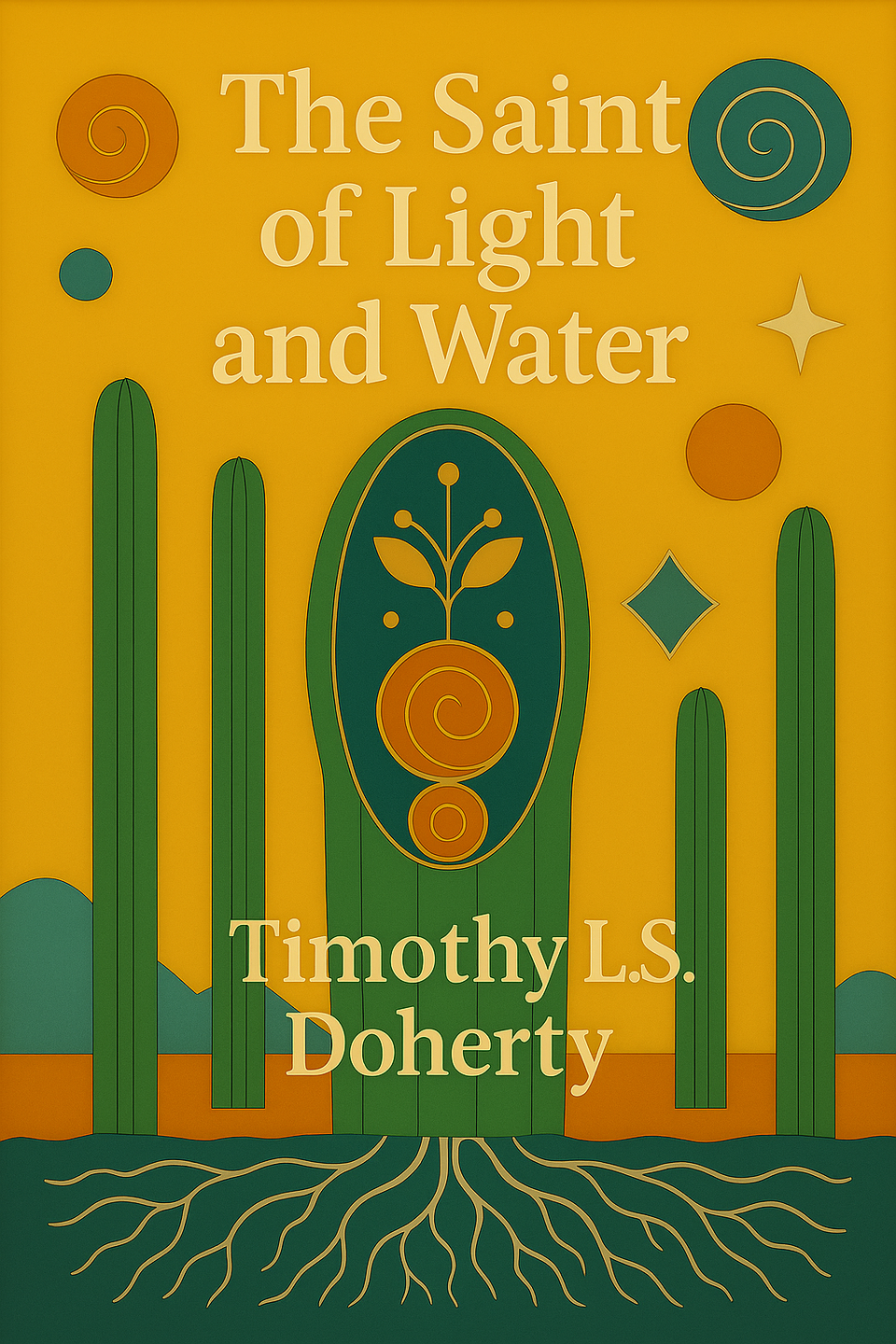
Saint of Light & Water
Prologue
The Saint of Light and Water is the record of an old medicine speaking through a new wound—an entheogenic element carried inside an eco-mythic story written for the healing of humankind.
The cactus around which our story is built first knew itself as Huachuma…the staff of vision tended by Andean curanderos for centuries.
Long before a single priest named it San Pedro, it was a bridge between breath and stone—a plant that remembered rain when humans forgot how to listen.
The Spaniards called it Saint Peter, linking it forever to the gate of heaven, and humankind responded by assuming it would deliver them to paradise.
The Quechua people of the Andes, where the cactus originates, simply called it teacher or Grandfather.
Because they knew the truth of the rift between man and earth.
Because the wound was never heaven’s to mend.
It takes very little logic, once that truth has been fully revealed, to realize that the gates of heaven are the last place one needs to be searching to repair our discord—and the ancestors recognized that.
The wound between earth and humankind was created by us.
It is ours to heal.
Our current climate crisis is not only one of spirit, but one of perception.
Somewhere between progress and forgetting, we lost the heart language of the old conversation.
We mistook that silence for victory.
But a true triumph is what happens when many beings find a rhythm that lets them all keep breathing.
Whoever speaks here speaks for all who remember.
The Saint of Light and Water remembers what I know to be true—not believe, but know.
The story ahead is a brief repair in the great exchange between matter and mercy, a little lantern lit to celebrate the moment when humans learned to listen again to the old conversation.
Mother Earth, patient as ever, replied.
She has never missed a beat.
She cannot.
For she is the pulse itself.
If huachuma is a teacher, its first classroom was the high Andean valleys of Peru and Ecuador.
For thousands of years it has grown on steep, stony slopes where clouds drag their bellies along the ridgelines, water is precious, and people learned to listen very carefully to both.
Traditional huachuma practice grew up in and around worked landscapes: terraces, irrigation canals, and smallholdings where water was directed with intelligence, and never wasted.
San Pedro is a highland cactus, not a lowland furnace cactus. Its architecture—tall, fast-growing columns with relatively thin skin—makes sense in places with bright light moderated by altitude and clouds, regular moisture pulses, and mineral soils that drain fast but still hold a trace of memory.
Far from those valleys, another hill has begun to answer to that same pattern.
Granada’s Costa Tropical is one of the very few places on earth where the cactus and the climate can meet on something close to equal terms: a subtropical outlier held between sea and mountain.
Granada boasts more than three hundred days of sun a year, winters gentle enough that frost forgets to come all the way down to the terraces.
Old acequias and gravity-fed channels still move water across our slopes the way Andean canals once did—arriving in pulses, not in floods, then slipping away so roots may drink without drowning.
It is a blessed ecology.
It is one honest glimpse of how mankind and Mother still tend to each other.
Most of my conviction about this coast doesn’t come from maps or climate data, or even the beautiful life it has readily given my family.
It comes from walking the seam where river, sea, and hill politely, and with a noble dignity, draw flexible terms with each other that allow for everyone to prosper.
You can start at the mouth of the Guadalfeo where it loosens into the Mediterranean—brown river folding into blue water. From there, if you follow the coastal camino on foot instead of by car, the story changes in small, steady increments: concrete to scrub, scrub to terraces, terraces to ravines and limestone cliffs that still remember what wild meant.
That still remember their old home at the bottom of the sea itself.
Somewhere between Motril and the first hard rise of the Alpujarras, you’ll start seeing the columns if you know where to look.
Not in curated shrine gardens, but in the background of actual work: a stand of pachanoi holding the corner of a mango terrace; a single old column leaning against a whitewashed caseta, ribs scarred from some forgotten storm; a row of rooted cuttings marching up a new bank where somebody decided erosion control and devotion could be the same job.
Further up, where the track turns to ruts and the wind comes straight down through the barranco, you find the men and women who keep those columns standing.
They don’t look like “plant medicine facilitators.”
They look like what they are: small farmers and peasant engineers in sun-bleached straw caps and Barça shirts from three seasons ago.
One hand on a saw, one hand on the trunk, talking to the cactus in the same half-muttered tone they use for their dogs and their tractors and the other things they respect deeply.
The cutting itself is never casual.
There’s always a pause—eyes up to the sky, across the slope, down toward the tank that’s already lower than they’d like. Only then do they lean in and start the teeth moving.
A length of cactus lets go with a soft, fibrous sigh and suddenly there is a question lying on the ground: roots or medicine?
Either way, the next move is patience.
The fresh-cut column doesn’t go straight into a pot or a brew. It gets laid gently on old boards or pallets in the shade, callus-side up to the dry air.
A week, two weeks, sometimes more—long enough for the wound to harden into something that can face soil again without rotting.
In that limbo, men walk past it with hoses and buckets, checking with the back of one knuckle the way you’d test a loaf of bread: is it ready yet?
When it is, the choreography shifts uphill.
On a south-facing terrace above Ítrabo or Vélez, a chestnut stake goes in first—driven deep into rubble soil made of broken ceramic tiles, river stone, and a century of fallen leaves.
Two men lift the column together, arms locked around spined green weight, and lean it into the stake until cactus, wood, and hillside find a shared center of gravity.
Strips of old irrigation hose or soft rope bind them together. The tie is never tight enough to bite, just firm enough to stand against the Levante when it comes screaming down the ravine at three in the morning.
It looks simple.
It isn’t.
Every decision—where to cut, where to root, how high to stake, how tight to tie—is a negotiation between plant, slope, and water that you cannot learn from books alone.
It’s tacit knowledge: the kind you do with your hands and your lower back, not with a survey.
From the outside, it might look like propagation for retreats.
On the ground, it’s older than that. It’s the same terrace logic that once kept wheat and olives and mulberries alive up here, now extended to a highland cactus that has proven it wants to stay. It wished to make a home here and thus, it did.
The men who do this work are not Andean curanderos.
They don’t pretend to be, and we shouldn’t pretend for them.
But they are, in a very real sense, the plant’s first line of priests on this coast: the people who decide where it stands, how it survives the winter, and whether it snaps or flexes when the next big wind comes.
The Andes will always be the original covenant. But if you stand on a south-facing terrace here at dusk—cactus ribs catching the last light, mango leaves sighing, avocado slowly ripening and the acequia whispering below—you can feel that the contract has been extended and resilience already achieved.
Not replaced.
Not copied.
Just continued, in a new dialect of the same old sun and the same ancient conversation.
In these pages, the San Pedro cactus carries its quiet gospel of light across oceans and empires, teaching that endurance—rightly understood—is a form of prayer.
If you read slowly enough, you may hear it breathe:
consciousness was never meant to belong to one species alone.
The Universal Sound that binds us all forbids exclusivity and insists on balance—
the kind that lets stone, bird, and human share the same weather without canceling out each other’s song.
This offering, left humbly in your keeping, is not a tale of escape…but a record of return.
The old medicines—especially Huachuma—do not open heaven;
they polish the hinge between worlds…
they shine the rusted gate between the seen and unseen.
They open the head and allow the heart to lead a conversation with the land. It is in this process that the human heals.
They remind us that perception, when tended, becomes devotion,
and devotion, when practiced, becomes repair.
If we learn again to hear the hum beneath our own noise,
the earth will not need to save or forgive us.
She will simply reach out,
take our hand,
and lead us home again.
This is a story about remembering how to listen.
Its medicine is not offered as doctrine or cure,
but as a metaphor for humility.
Every living thing carries instructions for balance.
The only question is whether we can still slow down enough to hear them.
What follows is not defense, nor sermon—
only a remembrance of the old conversation between the human heart and the breathing earth.
If it stirs anything in you,
let it be gentleness.
Selah.
Timothy L.S. Doherty
Ítrabo • Al-Andalus • España • Planet Earth